2026-04-02 中国科学院(CAS)
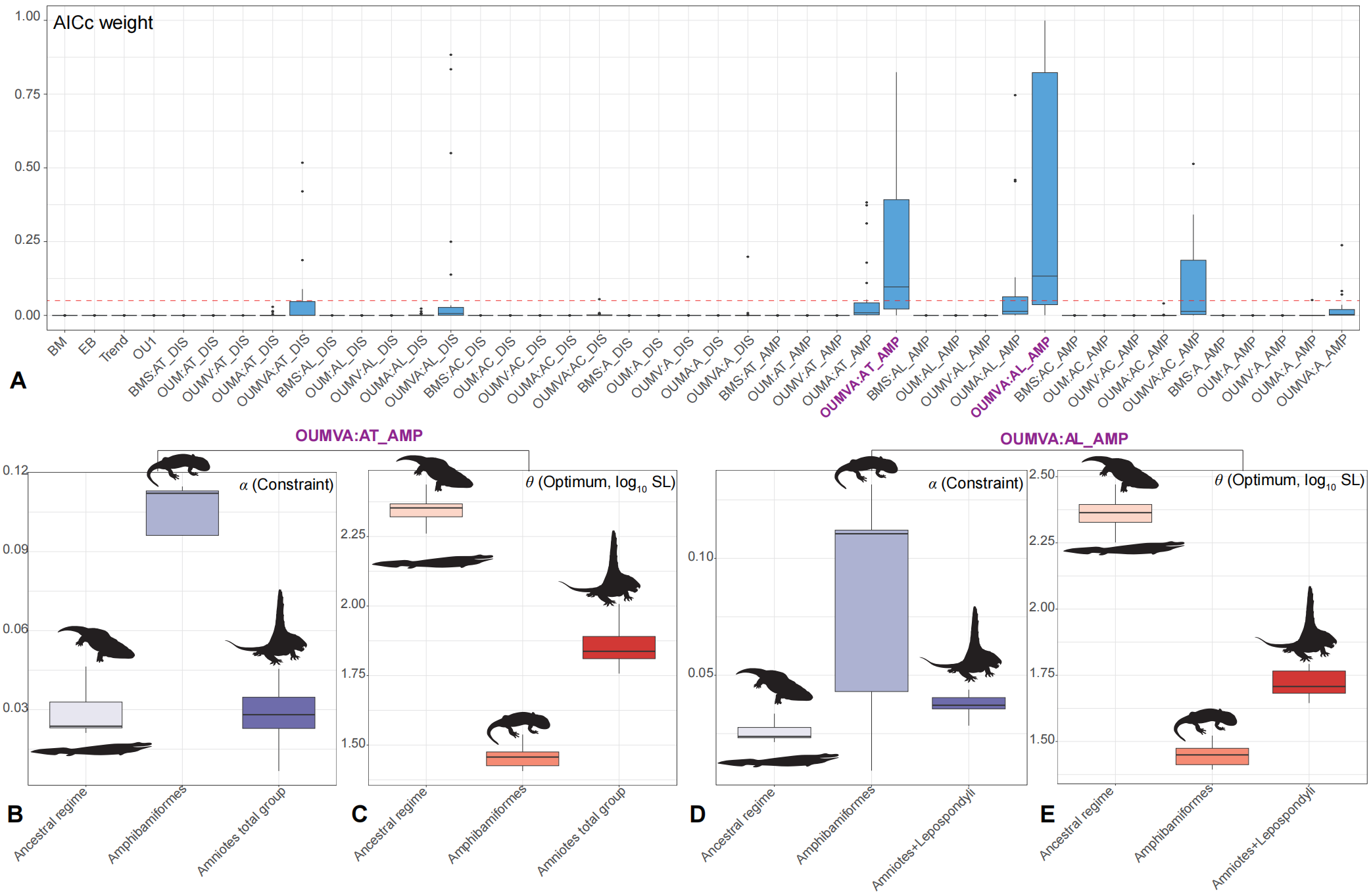
Results of evolutionary model fitting for body size (using log10 SL and dated trees constrained as Topology 1). (Image by YU Yilun et al.)
<関連情報>
- https://english.cas.cn/newsroom/research-news/202603/t20260331_1154293.shtml
- https://www.science.org/doi/10.1126/sciadv.aeb0801
陸生脊椎動物の出現における呼吸適応によって規定された、分離した表現型制約 Decoupled phenotypic constraints framed by respiratory adaptation in the rise of land vertebrates
Yilun Yu, Xing Xu, and Roger B. J. Benson
Science Advances Published:1 Apr 2026
DOI:https://doi.org/10.1126/sciadv.aeb0801
Abstract
Land vertebrates today comprise amniotes and lissamphibians, which have highly different modes of gas exchange, and distinct skull shapes and body size distributions. A central hypothesis of tetrapod evolution proposes a connection between these traits during their initial divergence, 335 million years ago. However, this has yet to be tested in a broad phylogenetic context. We investigate the evolution of body size, skull proportions, and respiratory traits among early land vertebrates, from the Middle Devonian to Early Permian using quantitative analysis of a dataset incorporating 344 species. We find that lissamphibian precursors show stronger constraints on body size than stem amniotes and increases in relative skull height were facilitated by relaxed constraints on the amniote stem lineage. These differences can be explained by respiratory innovations. Dependence on cutaneous gas exchange constrained lissamphibians and their close relatives to small body sizes, whereas rib-based lung ventilation relaxed constraints on skull shape and maximum body size in terrestrial amniotes.