2026-05-19 新潟医療福祉大学
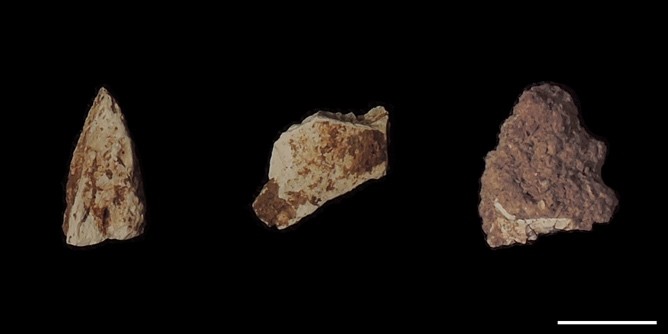
分析した焼骨片(スケール 5mm)
<関連情報>
SPring-8におけるシンクロトロン放射光X線CTを用いた後期更新世焼骨片の非破壊組織形態学的同定 Non-destructive histomorphological identification of Late Pleistocene burned bone fragments using synchrotron radiation X-ray CT at SPring-8
Junmei Sawada,Minoru Yoneda,Kentaro Uesugi,Masato Hoshino,Seiya Watanabe,Naoki Miyamoto,Kazuhiro Uzawa,Takeji Toizumi,Rin Anbo,Fumiko Saeki & Yuzo Yanagita
Scientific Reports Published:19 May 2026
DOI:https://doi.org/10.1038/s41598-026-50208-8
Abstract
Fukui Cave, located in the southwestern Japanese Archipelago, is a cave site containing cultural layers dating from the Late Pleistocene to the early Holocene. This study aimed to identify the animal taxa of burned bone fragments excavated from Layer IV of the cave, dated to approximately 16,000 years ago, using a non-destructive histomorphological approach. Because faunal remains are extremely scarce at Palaeolithic sites in the Japanese Archipelago, these specimens provide important evidence for understanding the relationship between humans and animals during the Late Pleistocene. However, all excavated bones were burned (calcined) fragments less than 1 cm in length, making macroscopic taxonomic identification difficult. To address this, synchrotron radiation X-ray computed tomography (voxel size: 2.74 μm) was performed at SPring-8 to analyze the internal bone microstructure. As a result, secondary osteons were identified in three of the seven burned fragments, and plexiform bone in one. The cross-sectional areas of osteons and Haversian canals were measured and compared statistically with reference data from various mammalian taxa, taking into account possible shrinkage due to burning. The results indicated that these fragments all fall within the range of medium-sized artiodactyls, such as deer or wild boar. In contrast, derivation from large mammals such as Naumann’s elephant or Yabe’s giant deer, which were extinct in the Late Pleistocene, can be excluded. These findings demonstrate the effectiveness of non-destructive histomorphological identification using high-resolution CT for burned bone fragments and provide new insights into animal exploitation by Late Pleistocene humans in the Japanese Archipelago.