2026-04-01 慶應義塾大学,東京科学大学
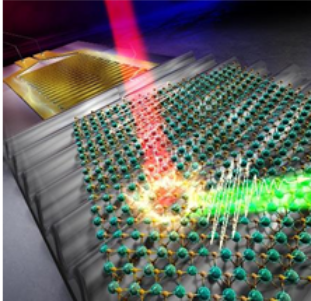
音響波を駆使した原子層二次元材料の波長変換の高速制御の模式図。
<関連情報>
- https://www.keio.ac.jp/ja/press-releases/2026/4/1/28-173483/
- https://www.keio.ac.jp/ja/press-releases/files/2026/4/1/260401-2.pdf
- https://pubs.acs.org/doi/10.1021/acs.nanolett.6c00268
単層遷移金属ジカルコゲナイドにおける第二高調波発生の超高速音響変調 Ultrafast Acoustic Modulation of Second-Harmonic Generation in Monolayer Transition-Metal Dichalcogenides
Takumi Yamamoto,Hidetoshi Kanzawa,Yuta Takahashi,Hajime Kumazaki,Jiang Pu,Shinichi Watanabe,and Shun Fujii
Nano Letters Published: March 9, 2026
DOI:https://doi.org/10.1021/acs.nanolett.6c00268
Abstract
High-speed modulation and deterministic control of optical nonlinear processes in nanomaterials are essential for realizing future nanoscale optoelectronic devices. Applying strain is a ubiquitous and versatile approach to deform atomically thin materials, allowing direct modification of their electronic and optical properties. Yet, strain engineering of nonlinear processes has so far relied predominantly on static approaches, which inherently limit modulation speed, reproducibility, and device scalability. Here, we demonstrate ultrafast acoustic modulation of second-harmonic (SH) generation in monolayer transition-metal dichalcogenides using surface acoustic waves (SAWs). By employing a fully phase-synchronized SH measurement combined with stroboscopic surface displacement detection, we directly visualize dynamic SH modulation at a frequency of 226 MHz. Moreover, theoretical modeling and determination of photoelastic coefficients enable quantitative extraction of the SAW-induced dynamic strain. Our results establish a direct link between acoustic fields and optical nonlinearities, providing a robust platform for dynamic strain engineering in two-dimensional nanophotonic devices.