2026-09-18 中国科学院(CAS)
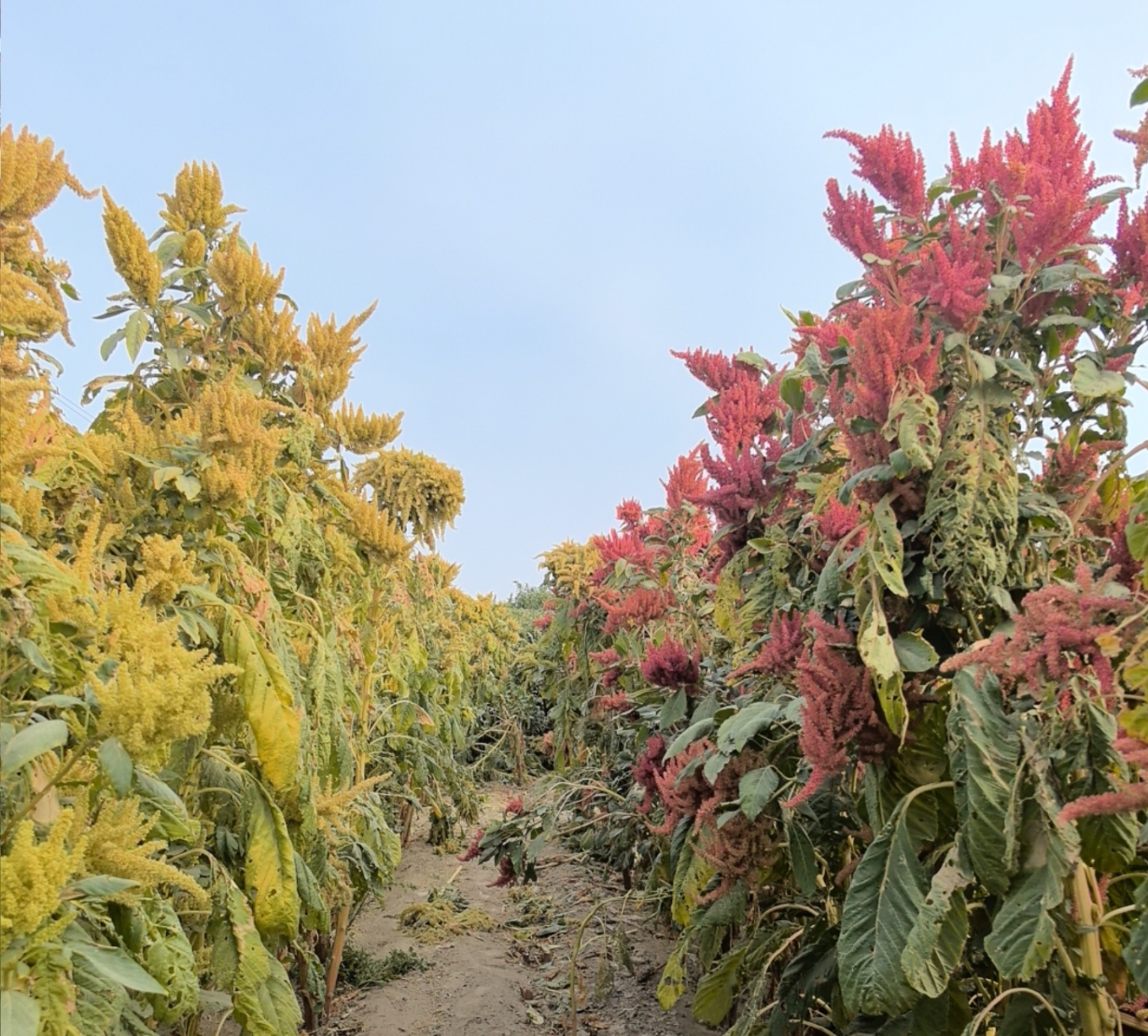
Grain amaranth at the saline-alkaline experimental site in Yuli county. (Image by WAN Jinpeng)
<関連情報>
- https://english.cas.cn/newsroom/research-news/202609/t20260918_1200867.shtml
- https://www.sciencedirect.com/science/article/pii/S277311112600104X
穀物アマランサスにおけるCeO2およびZnOナノ粒子を介した塩類およびアルカリ性ストレス耐性のマルチオミクス解析 Multi-omics dissection of CeO2 and ZnO nanoparticle-mediated saline and alkaline stress tolerance in grain amaranth
Shixia Lan, Yunfang Li, Biru Alemu Chali, Dandan You, Yang Zhang, Tianhui Kuang, Guizhou Liu, Peng Xu, Jinpeng Wan
Plant Nano Biology Available online: 14 September 2026
DOI:https://doi.org/10.1016/j.plana.2026.100348
Highlights
- CeNP and ZnONP significantly rescued shoot length decline induced by saline and alkaline stress.
- CeNP and ZnONP enhanced seedling growth by modulating antioxidant capacity and osmoprotectant accumulation.
- Glutathione, tryptophan, and riboflavin metabolism were co-regulated under both stresses.
- CeNP and ZnONP induced ABC transporters and alanine, aspartate and glutamate metabolism under both stresses.
- Integrated omics analysis underscored pathways like amino acid, phenylpropanoid biosynthesis, and ROS detoxification critically involved in stress response.
Abstract
Soil salinization is reducing agricultural productivity. Amaranth shows promise for cultivation in such soils, but the mechanisms underlying its responses to saline and alkaline stress remain poorly understood. In this study, Amaranthus cruentus was used to investigate how foliar-applied cerium oxide nanoparticles (CeNP) and zinc oxide nanoparticles (ZnONP) enhance amaranth performance under saline (NaCl) and alkaline (Na2CO3, pH 8.5) stress. Nanoparticles alleviated stress-induced growth inhibition, restoring seedling height and enhancing root development. Compared with NaCl stress, CeNP and ZnONP increased seedling height by 11.15% and 11.32%, and root fresh weight by 32.71% and 23.04% under NaCl stress, respectively. Additionally, they similarly enhanced seedling height by 12.61% and 13.10% under alkaline stress. Consistently, SPAD value and chlorophyll declined under both stresses, indicating severe oxidative damage; however, nanoparticle treatments facilitated seedling growth by modulating antioxidant capacity and osmoprotectant accumulation. Alkaline stress triggered a stronger transcriptional disturbance than saline stress. Key gene networks were enriched in ion transport, reactive oxygen species detoxification and redox balance, cell wall remodeling, and osmotic adjustment. WGCNA identified growth trait-associated modules and transcription factors associated with saline and alkaline tolerance. Combined transcriptome and metabolome pathway analysis identified coordinated regulation of glutathione and riboflavin metabolism, tryptophan metabolism, linked to auxin signaling, phenylpropanoid/flavonoid biosynthesis, and ABC transporter pathways. Overall, CeNP and ZnONP enhance amaranth resilience to saline and alkaline stress by coordinately regulating ion homeostasis, antioxidant defense, carbon- and hormone-related metabolism, and transport processes. These findings provide insights for applying nanobiotechnology to sustain crop productivity in saline and alkaline environments.