2026-10-20 中国科学院(CAS)
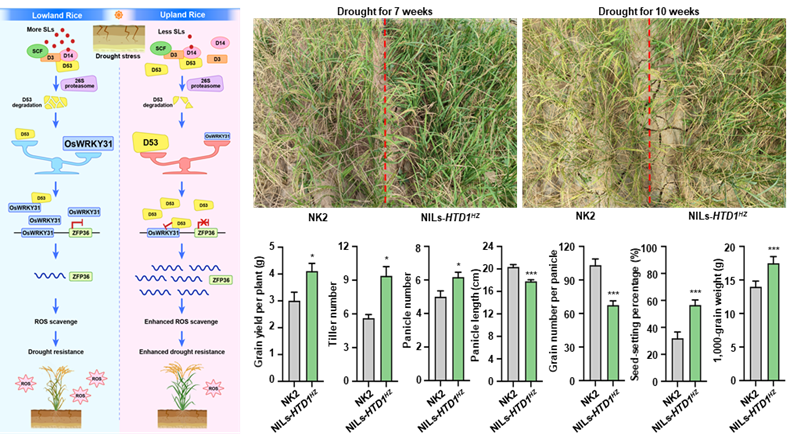
Strigolactone pathway reduces drought resistance in both paddy and upland rice, which has significant implications for future breeding strategies. (Image by IGDB)
<関連情報>
- https://english.cas.cn/newsroom/research-news/202610/t20261020_1209187.shtml
- https://www.cell.com/molecular-plant/abstract/S1674-2052(26)00301-1
ストリゴラクトンは、D53–OsWRKY31–ZFP36モジュールを介した活性酸素種除去を抑制することにより、イネの干ばつ順化を制限する Strigolactones constrain rice drought acclimation by suppressing ROS scavenging through the D53–OsWRKY31–ZFP36 module
Qianqian Li ∙ Yi Wang ∙ Jijun Yan ∙ … ∙ Jinfang Chu ∙ Jiayang Li ∙ Bing Wang
Molecular Plant Published:September 3, 2026
DOI:https://doi.org/10.1016/j.molp.2026.09.001
ABSTRACT
Strigolactones (SLs) are a class of plant hormones essential for tiller development and yield under diverse environmental conditions. Drought is a major limiting factor for rice yields. Although SLs contribute to drought resistance, mechanisms and practical applications of SL pathway in drought acclimation of rice remain poorly understood. Our study shows that short-term dehydration represses SL biosynthesis in rice roots. Genetic assays indicate that disruption of SL biosynthesis or signaling elevates rice drought resistance, whereas SL signaling activation or supplementation with the SL analog GR244DO impairs drought resistance. SLs negatively regulate drought acclimation by promoting degradation of the repressor protein DWARF53 (D53). D53 interacts with the transcription factor OsWRKY31 via its N-terminal domain and suppresses the protein level of OsWRKY31, which binds to and represses transcription of the ZFP36 promoter. ZFP36 encodes a zinc-finger transcription factor that promotes H2O2 scavenging to sustain reactive oxygen species (ROS) homeostasis during drought stress. Notably, the drought-resistant upland rice variety IRAT109 exhibits lower SL levels in root exudates than the lowland rice variety Nipponbare (NP). Genome editing of key components in SL pathway enhances drought resistance in NP, Huazhan (HZ), and IRAT109. The agronomic potential of tuning SL biosynthesis is further supported by the elite D17/HTD1 allele, which weakens SL biosynthesis and improves drought resistance and grain yield in Nekken 2 (NK2) under field conditions. These findings uncover a key mechanism underlying SL-repressed drought acclimation in rice and provide an effective strategy to improve drought resistance in diverse rice varieties amid ongoing climate change.