2026-11-16 中国科学院(CAS)
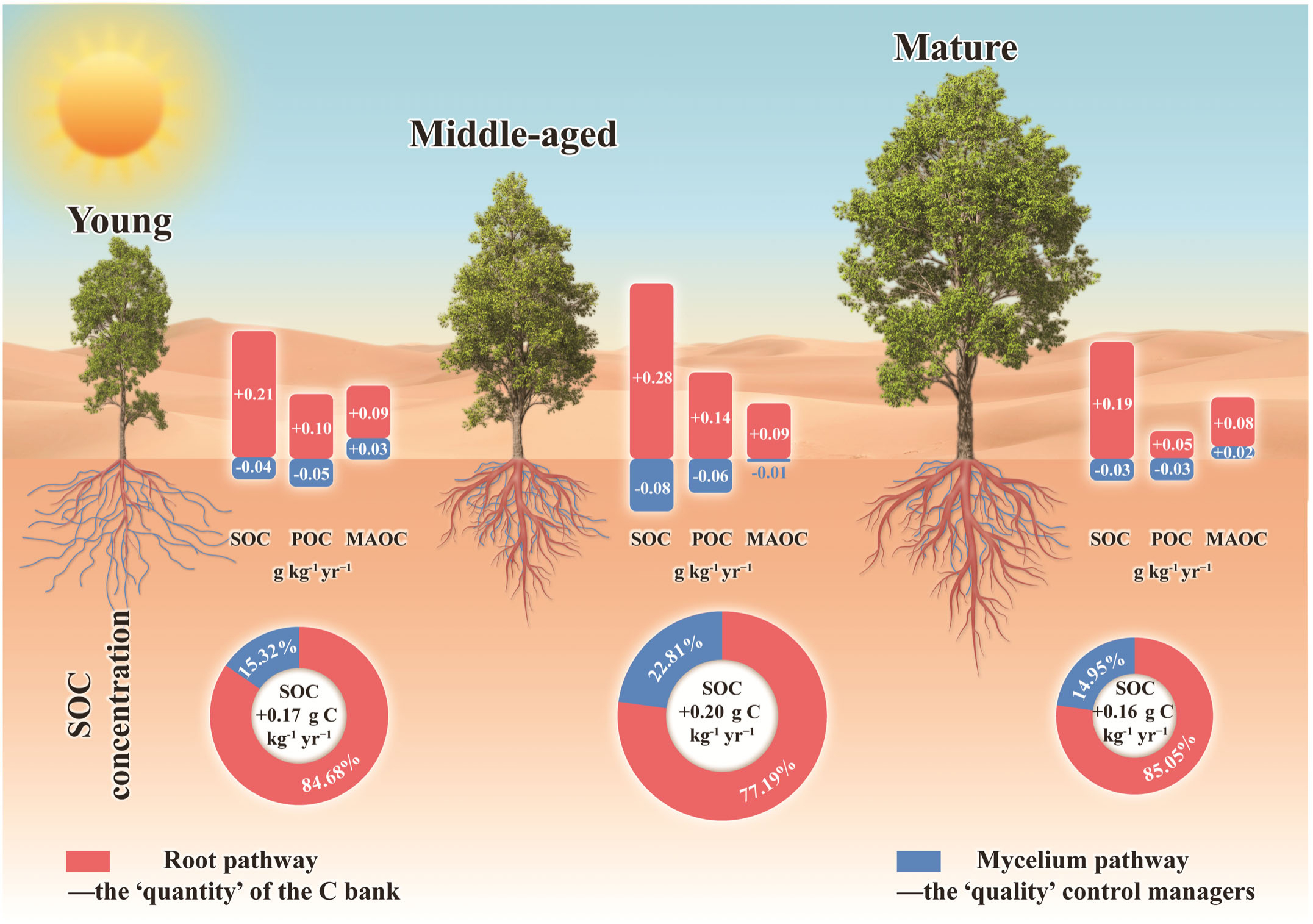
Soil organic carbon (SOC) pool dynamics during Populus alba var. pyramidalis Bge. afforestation in a hyper-arid by root pathway and mycelium pathway. (Image by XIEG)
<関連情報>
- https://english.cas.cn/newsroom/research-news/202611/t20261116_1219224.shtml
- https://nph.onlinelibrary.wiley.com/doi/10.1111/nph.71737
超乾燥地域の植林における、根を主因とする土壌有機炭素の純増と菌糸を介した炭素損失の二面性(Duality of root-dominated net soil organic carbon gain and mycelium-mediated carbon loss in hyper-arid afforestation)
Xinping Dong, Yanju Gao, Akash Tariq, Xiaozhen Pu, Corina Graciano, Zhihao Zhang, Jordi Sardans, Josep Peñuelas, Weiqi Wang, Fanjiang Zeng
New Phytologist(Early View、Version of Record)2026-11-04
DOI:10.1111/nph.71737
Afforestation in drylands can promote soil organic carbon (SOC) sequestration, but plant roots and fungal mycelia differ in their carbon inputs and their effects on decomposition and stabilization. This study investigated these contrasting pathways across a dryland afforestation chronosequence comprising young, middle-aged, and mature forests. Using the ingrowth-core method, the researchers quantified the contributions of root and mycelium pathways to SOC dynamics. The root pathway increased SOC through inputs of particulate organic carbon and mineral-associated organic carbon, accounting for 77.19–85.05% of SOC changes. In contrast, the mycelium pathway caused a net loss of SOC through the depletion of particulate organic carbon, accounting for 14.95–22.81% of the changes. SOC concentrations were highest in middle-aged forests, whereas relative SOC stability peaked in young forests. These findings indicate that soil carbon sequestration during dryland afforestation depends not only on carbon inputs but also on forest development and the contrasting roles of roots and fungal mycelia. Afforestation management should therefore consider stage-specific root and mycelial traits to improve carbon sequestration in arid forests.