2026-09-24 京都大学
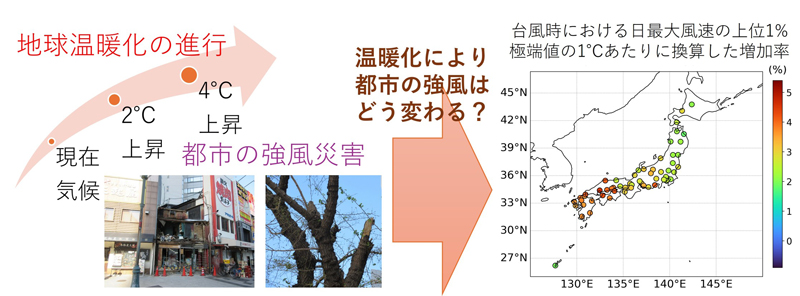
イラスト・写真:竹見哲也
<関連情報>
- https://www.kyoto-u.ac.jp/ja/research-news/2026-09-24-0
- https://www.kyoto-u.ac.jp/sites/default/files/2026-09/web-2609-Kakemi-c18fdf558f55b1a9ca908e5fe1223fd8.pdf
- https://www.jstage.jst.go.jp/article/jwe/51/3/51_20/_article/-char/ja
d4PDFを用いた将来気候における全国主要都市の強風ハザード評価
中 七海, Sandhyarani NAYAK, 竹見 哲也
日本風工学会論文集 公開日: 2026/09/24
DOI:https://doi.org/10.5359/jwe.51.20
抄録
This study assesses future changes in strong wind hazards across 58 major cities in Japan using a large-ensemble climate dataset, the database for Policy Decision making for Future climate change (d4PDF). To address systematic biases in model wind speeds, quantile mapping (QM) and quantile delta mapping (QDM) were applied with the use of observational data as the reference. Statistical analyses were conducted for the climates of the present and under +2 °C and +4 °C warming scenarios, with a particular focus on extreme wind speeds and their association with tropical cyclones. The results show that mean wind speeds exhibit little change or slight decreases, whereas only the upper-most-percentile extreme winds intensify under future climates. This increase is primarily attributed to typhoon-related winds, while non-typhoon conditions show minimal changes. Although the frequency of typhoon occurrences decreases, their intensity increases, leading to enhanced extreme wind risks, particularly in lower latitudes and extending to northern Japan under the higher warming scenario.