2026-11-05 中国科学院(CAS)
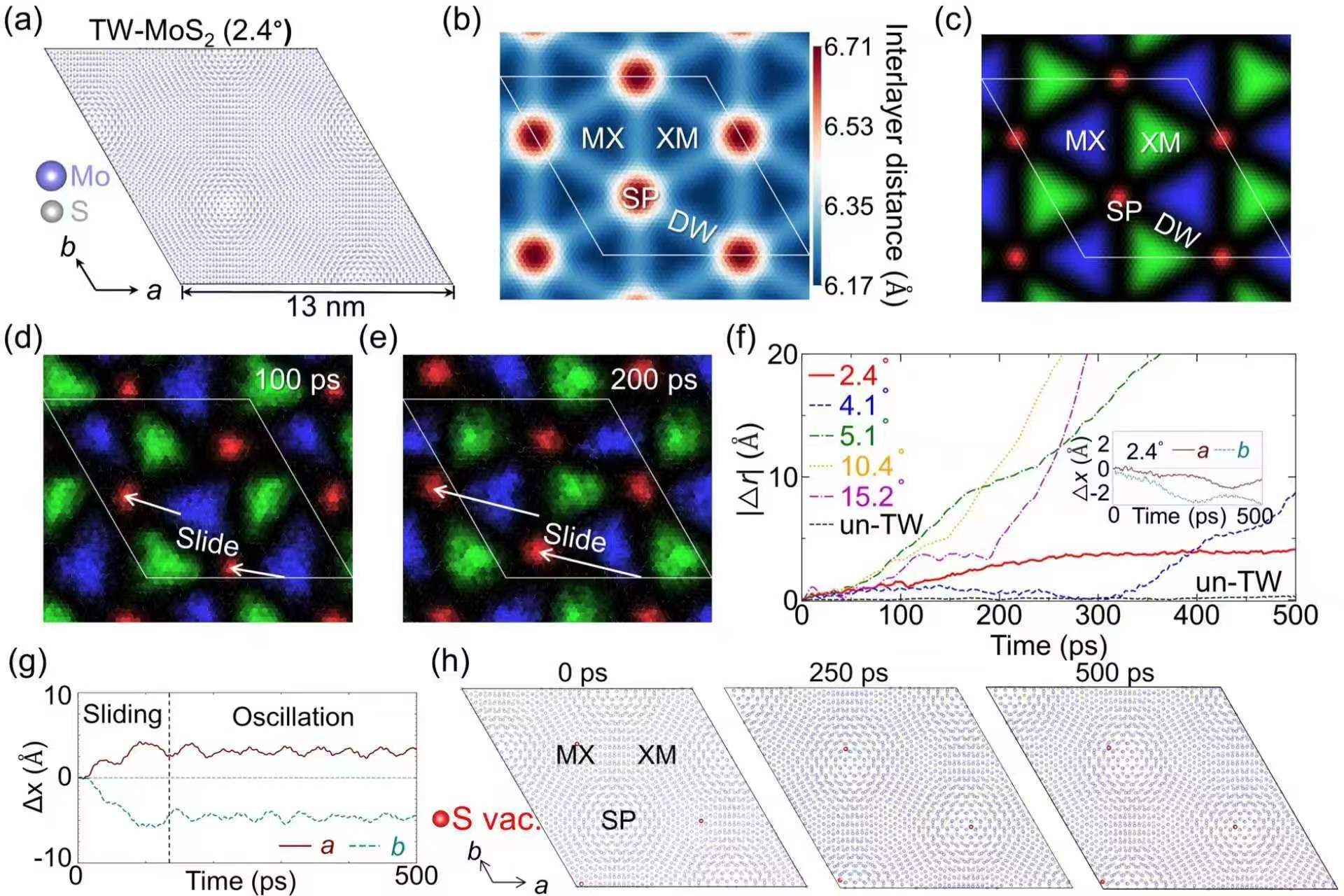
Room-temperature spontaneous sliding and sulfur-vacancy-induced pinning in moiré superlattices (Image by ZHANG Jin et al.)
<関連情報>
- https://english.cas.cn/newsroom/research-news/202611/t20261105_1213291.shtml
- https://pubs.acs.org/jacsat/article-abstract/148/40/43482/5442117/Domain-Wall-Mediated-Ultralow-Barrier-Sliding-and
機械学習によって明らかになった、強誘電体モアレ超格子におけるドメイン壁を介した超低障壁滑りおよびピン止め現象 Domain-Wall-Mediated Ultralow-Barrier Sliding and Pinning in Ferroelectric Moiré Superlattices Revealed by Machine Learning
Jia-Wen Li; Sheng Meng; Xinghua Shi; Jin Zhang; Wei-Hai Fang
Journal of the American Chemical Society Published:September 30, 2026
DOI:https://doi.org/10.1021/jacs.6c13431
Abstract
Sliding ferroelectrics built from stacked nonpolar monolayers enable out-of-plane polarization and unconventional switching via interlayer sliding, yet the microscopic sliding dynamics remain unclear. Using machine-learning molecular dynamics, we reveal spontaneous, thermally driven interlayer sliding in ferroelectric MoS2 moiré superlattices, with relative velocities on the order of 1 m/s at 300 K. Instead of rigid translation of the entire bilayer, the motion appears as a global drift of the moiré pattern. Such thermally driven sliding is inconsistent with a meV/atom-scale rigid-sliding barrier. In contrast, when constrained relaxation is allowed, the sliding proceeds along an almost barrierless pathway that directly reproduces the global drift of the moiré pattern. Furthermore, sulfur vacancies trigger a sliding-to-pinning transition, with ∼0.1% S vacancies already sufficient to convert the long-range sliding into localized oscillations. This pinning originates from the stacking-dependent vacancy energy, whose minimum at the nodes of domain-wall networks defines pinning centers, as further supported by the dynamical sliding-to-pinning process. Energetic analysis attributes the thermally driven sliding-to-pinning transition to competition between defect-induced pinning and moiré deformation. These results reveal that the sliding process in strongly reconstructed moiré superlattices is governed by a domain-wall-mediated collective reconstruction pathway with an ultralow barrier, rather than rigid layer translation, deepening the understanding of microscopic dynamics in moiré superlattices and sliding ferroelectrics.