2026-09-18 愛媛大学
<関連情報>
- https://www.ehime-u.ac.jp/data_relese/pr_20260918_cmes/
- https://www.sciencedirect.com/science/article/pii/S2590182626001529
凍結粉砕タイヤトレッド粒子(CMTT)の慢性的な経口ばく露は、コイの成長には影響しないが、血液毒性を引き起こす Chronic dietary exposure to cryo-milled tire tread (CMTT) causes hematotoxicity without growth inhibition in common carp
Kei Nakayama, Rina Wada, Tatsuya Kunisue, Rumi Tanoue, Akitoshi Goto, Shinpei Wada, Osamu Kurata, Kosuke Tanaka, Yusuke Takahashi, Atsuko Amano, Takuya Itaki, Seiichi Uno, Go Suzuki
Environmental Chemistry and Ecotoxicology
DOI:https://doi.org/10.1016/j.enceco.2026.08.013
Highlights
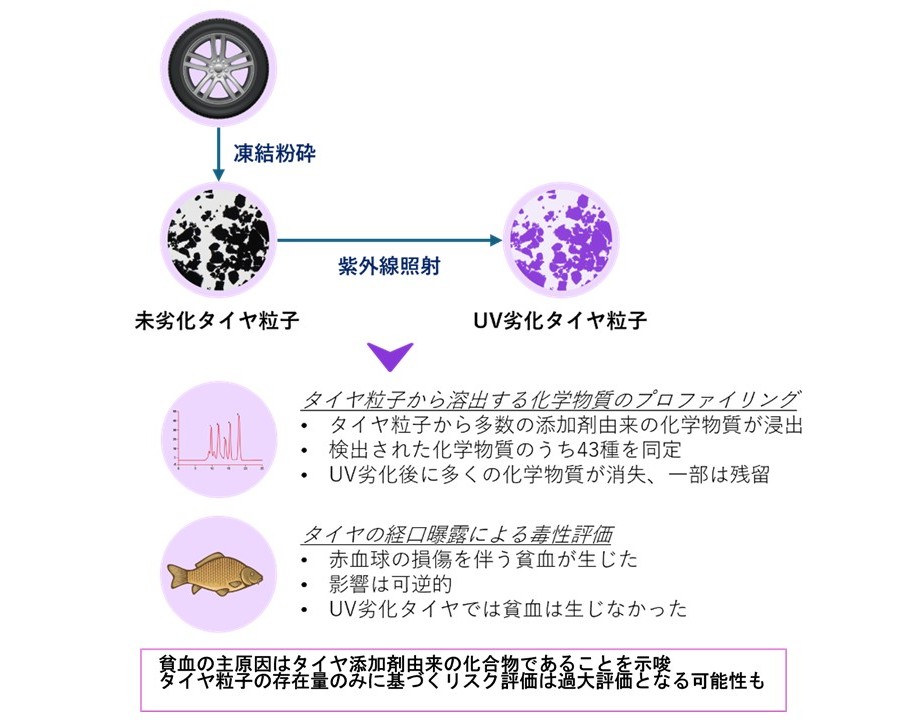
- CMTT (>0.75 mg/g-body weight/day) induced anemia in carp without affecting growth.
- Dose-dependent hemosiderin accumulation in spleen indicated erythrocyte damage.
- Anemia and related hematological effects were reversible after a recovery period.
- UV-irradiated CMTT did not cause hematotoxicity in common carp.
- Tire additives, not particles, were likely responsible for the observed anemia.
Abstract
This study investigated the chemical composition of leachate from cryo-milled tire tread (CMTT) and evaluated whether chronic dietary exposure to CMTT induces hematological toxicity in common carp (Cyprinus carpio), including whether UV-induced aging alters toxicity, to support ecological risk assessment of tire-derived particles and associated chemicals. Three independent exposure experiments were conducted. In Test 1, carp were fed diets containing 0%, 2.5%, and 10% CMTT for four weeks. Tests 2 and 3 exposed carp to diets containing 0%, 0.625%, 1.25%, and 2.5% CMTT (Test 2) and 0%, 1.25%, 2.5%, and 5% UV-irradiated CMTT (Test 3) for two weeks. The CMTT used in this study was provided by the U.S. Tire Manufacturers Association. No mortality was observed in any test. Although Test 1 showed no significant effects on growth parameters, hemoglobin (Hb) and hematocrit (Ht) levels were significantly lower in the 2.5% and 10% CMTT groups compared with the control (p < 0.005 for Hb; p < 0.05 for Ht). Additionally, increased hemosiderin deposition in the spleen indicated erythrocyte damage. In Test 2, a significant reduction in Hb was observed only in the 2.5% CMTT group (p = 0.0407). Based on Tests 1 and 2, the lowest-observed-effect level and no-observed-effect level for CMTT-induced anemia were estimated to be 0.75 and 0.375 mg/g body weight/day, respectively. Test 3, which used UV-degraded CMTT, showed no significant change in Hb levels. As UV irradiation markedly reduced many chemical concentrations in the CMTT leachate—some of which are known to induce anemia—the results suggest that tire additives were likely the primary cause of the observed anemia. While the CMTT used in this study is representative of North American tire products and may differ in shape and chemical composition from environmentally relevant tire and road wear particles, these results provide benchmark toxicity thresholds and chemical context for screening-level ecological risk assessment.