2026-11-02 マサチューセッツ工科大学(MIT)
<関連情報>
- https://news.mit.edu/2026/mit-engineers-design-safer-more-efficient-vaccination-system-farmed-fish-1102
- https://pubs.acs.org/ancac3/article-abstract/doi/10.1021/acsnano.6c06013/5462126/Design-of-Water-Resistant-Food-Grade-Microneedles
魚類への注射および水中貨物輸送用の耐水性食品グレードマイクロニードルの設計 Design of Water-Resistant, Food-Grade Microneedles for Fish Injection and Underwater Cargo Delivery
Meng Li; Jad Raad; Yunteng Cao; Yue Hu; Colleen Wolfe; Doyoon Kim; Bradley D. Frank; Gregory D. Wiens; Benedetto Marelli
ACS Nano Published:November 02, 2026
DOI:https://doi.org/10.1021/acsnano.6c06013
Abstract
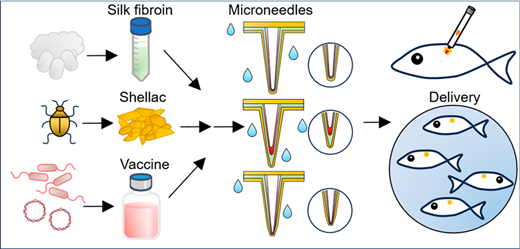
Aquatic foods provide around 15% of consumed animal-derived protein worldwide and aquaculture now supplies most of it. But the industry faces significant challenges in disease prevention and excessive use of antimicrobials. Vaccination, particularly for juvenile fish, can mitigate these risks, but manual and automated needle-based vaccination methods are costly, stressful, and labor-intensive. Here, a water-resistant, food-grade microneedle platform is designed to deliver cargos underwater. Silk fibroin-based microneedles are engineered to remain water resistant from minutes to hours in order to penetrate fish skin in wet conditions. To meet the requirements of different underwater applications, three microneedle morphologies─shell, solid-tip, and hollow─are developed, and their different combinations of mechanical integrity, water-resistance performance, cargo compatibility, and release kinetics are studied. The microneedles also preserve the supercoiled conformation of ⩾50% of the loaded pIHNVw-G plasmids─developed to protect fish against infectious hematopoietic necrosis virus─outside the cold chain for 4 weeks under dry conditions. In pilot animal studies, injected microneedles remain attached to zebrafish and juvenile rainbow trout while swimming. Using this food-based microneedle platform, we envision the development of tools for underwater vaccination of juvenile fish that increase aquaculture efficiencies and reduce environmental impact.