2026-11-05 ペンシルベニア州立大学(Penn State)
<関連情報>
- https://www.psu.edu/news/materials-research-institute/story/atom-scale-model-could-help-improve-material-growth-advanced
- https://pubs.acs.org/jpccck/article/130/35/12550/5285474/Atomistic-Insights-into-SiC-Sublimation-and
ReaxFF分子動力学シミュレーションによるSiC昇華と温度依存性蒸気組成の原子レベルでの解析 Atomistic Insights into SiC Sublimation and Temperature-Dependent Vapor Composition by ReaxFF Molecular Dynamics Simulations
Yun Kyung Shin; Ga-Un Jeong; Mengyi Wang; Katherine Thompson; Anirban Phukan; Riasat Islam; Joshua A. Robinson; Yuan Xuan; Adri C. T. van Duin
The Journal of Physical Chemistry C Published:August 21, 2026
DOI:https://doi.org/10.1021/acs.jpcc.6c03672
Abstract
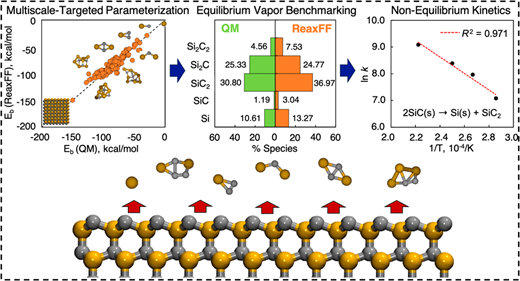
We developed a ReaxFF force field for silicon carbide (SiC), specifically parametrized to capture complex, temperature-dependent vapor compositions during sublimation. ReaxFF molecular dynamics (MD) simulations of crystalline SiC at 3000–4500 K revealed a diverse range of vapor species─including SiC2, Si, Si2C, Si2C2, SiC, Si2C3 and Si3C2─closely mirroring equilibrium compositions derived from quantum mechanical (QM) benchmarks. Our simulations demonstrate that the initial stage of sublimation is Si-rich at 3000 K but transitions toward C-rich compositions at elevated temperatures, informing stoichiometry control in SiC growth. To bridge atomistic and macroscopic scales, Arrhenius analysis was employed to extract kinetic parameters for computational fluid dynamics (CFD) modeling, providing an extended kinetic description critical for optimizing SiC crystal growth. Finally, the ReaxFF force field was successfully benchmarked against a previously developed state-of-the-art machine learning potential in both accuracy and computational efficiency, establishing it as a robust tool for multiscale crystal growth simulations.