2026-11-05 中国科学院(CAS)
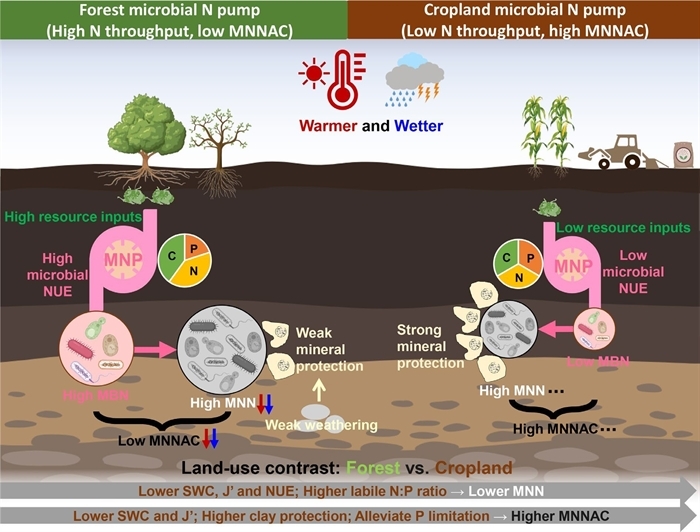
Conceptual framework for land-use-specific associations of the microbial nitrogen pump along climatic gradients. (Image by Prof. LI Dejun’s research group)
<関連情報>
- https://english.cas.cn/newsroom/research-news/202611/t20261105_1213292.shtml
- https://onlinelibrary.wiley.com/doi/10.1111/gcb.71160
論文タイトル Divergent Spatial Climate Associations of the Microbial Nitrogen Pump Across a Subtropical Cropland-Forest Transect
Xinyi Yang, Pengpeng Duan, Lifei Sun, Peilei Hu, Tiangang Tang, Hongzhao Yuan, Kongcao Xiao, Xunyang He, Kelin Wang, Dejun Li
Global Change Biology Published: 28 October 2026
DOI:https://doi.org/10.1111/gcb.71160
Abstract
Soil microbial necromass nitrogen (MNN) represents a persistent organic N pool, yet how land use modulates its spatial content and biomass-normalized ratio across climatic gradients remains elusive. Across paired forest and cropland soils spanning a subtropical climatic gradient in southwestern China, we quantified fungal, bacterial, and total MNN contents using amino sugar biomarkers. Microbial N growth and gross N mineralization were measured using 18O-H2O tracing and 15N pool dilution, respectively, and were combined to estimate microbial N use efficiency (NUE). We then compared MNN content and its accumulation coefficient between land uses and examined their associations with mean annual temperature (MAT), mean annual precipitation (MAP), and microbial NUE. Forest soils contained 341.4% more fungal necromass N and 150.6% more total MNN than croplands, but had a lower microbial necromass N accumulation coefficient (MNNAC), defined as the ratio of MNN to microbial biomass N (MBN). In forests, fungal and total microbial necromass N contents, as well as fungal and total microbial necromass N accumulation coefficients, were negatively associated with both MAT and MAP, whereas corresponding climatic associations were weak or absent in croplands. Microbial NUE was positively associated with MNN content in forest soils but negatively associated with MNN content in croplands. In contrast, a significant negative association between NUE and MNNAC was observed only in cropland soils. Multivariate analyses identified distinct correlates of MNN: weathering, plant biomass, resource availability, and soil organic matter evenness in forests, but clay-mediated mineral protection and resource stoichiometric imbalance in croplands. These findings indicate that land use redefines the spatial climate associations of the microbial N pump, suggesting context dependence within the Microbial Efficiency–Matrix Stabilization (MEMS) framework and supporting the inclusion of land-use context in Earth system models of terrestrial nitrogen feedbacks under global change.