2026-11-05 東北大学
東北大学と日本原子力研究開発機構の研究チームは、磁性体において量子幾何に由来する「非線形ホール状態」を室温で観測し、電流によって制御することに成功した。研究対象は、トポロジカル反磁性体であるマンガン・スズ化合物(Mn₃Sn)。量子幾何とは、物質中の電子の量子状態が運動量空間で示す幾何学的性質であり、ベリー曲率や量子計量などで特徴づけられる。研究チームは、量子幾何に由来する非線形ホール応答が磁気秩序と対応することに着目し、電流によって生じるスピン軌道トルクを利用して磁気秩序を変化させた。その結果、電流を操作することで非線形ホール電圧の向きを反転させることができた。従来は非線形伝導現象の観測や物理的解明が中心だったが、本成果はその応答を電気的に制御できることを示した。将来的には、電気信号の周波数変換・増幅などを実現する次世代スピンデバイスへの応用が期待される。
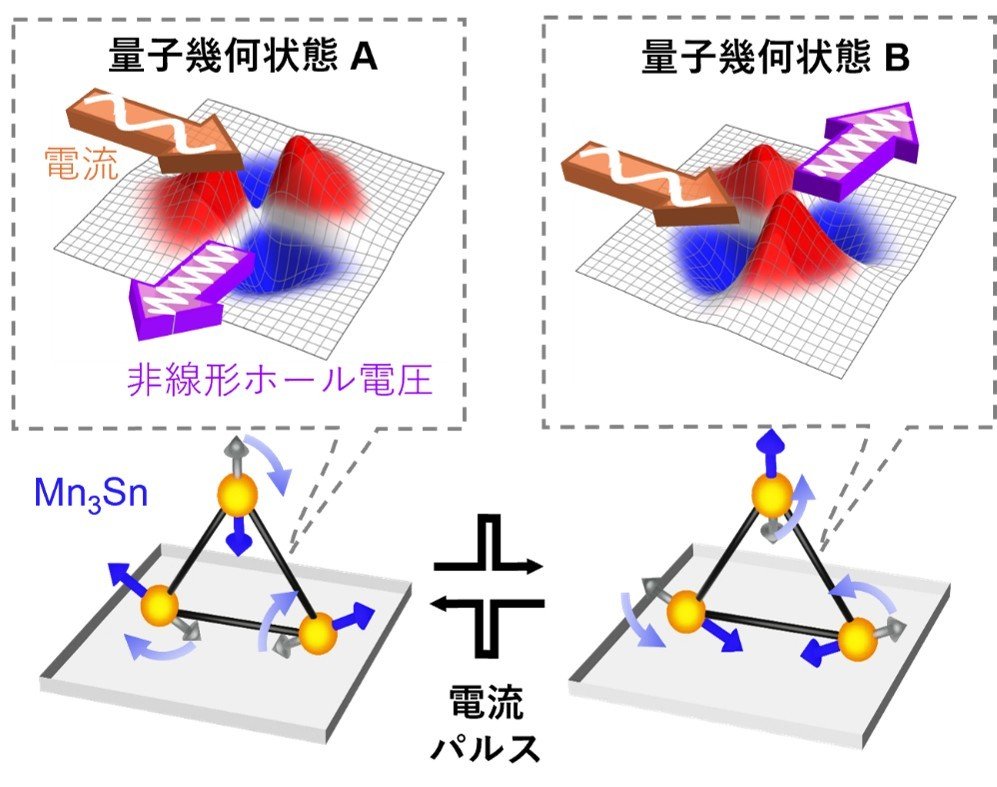
図1. 磁気秩序を介した量子幾何由来の非線形ホール状態の電流制御。Mn3Snの磁気秩序を電流で制御することで、量子幾何に由来する非線形ホール状態を制御します。図の左右は異なる磁気秩序を示しており、磁気秩序の変化に伴って非線形ホール電圧の向きが反転します。
<関連情報>
キラル反強磁性体における量子幾何学的非線形ホール状態の電流操作
Electric-current manipulation of quantum-geometric nonlinear Hall state in a chiral antiferromagnet
Tomohiro Uchimura ∙ Jiahao Han ∙ Yasufumi Araki ∙ … ∙ Jun’ichi Ieda ∙ Hideo Ohno ∙ Shunsuke Fukami
Newton Published:November 4, 2026
DOI:https://doi.org/10.1016/j.newton.2026.100722
Highlights
•Manipulation of the quantum geometric nonlinear Hall (QgNLH) state by current
•Interplay between the QgNLH state and the current-induced spin dynamics
•Quantum geometry as tunable degrees of freedom in practical nonlinear devices
•Revealing the basis for the electrical driving of novel quantum-geometric responses
Summary
Quantum-geometric nonlinear Hall (QgNLH) states characterize an important family of quantum systems that integrate quantum-geometric origins, distinct symmetry dependences, and nonlinear transverse voltage-current responses. To functionalize QgNLH states, on-demand electrical manipulation is essential but remains challenging. Here, by bridging nonlinear electronics, geometric physics, and spintronics in a topological magnet, we propose and demonstrate the conception of manipulating QgNLH states by electric current. In an epitaxial thin film of chiral antiferromagnet Mn3Sn, we first observe a nonlinear Hall effect, which flips sign by reversing the chiral-spin structure in a non-volatile manner, and provide evidence for its quantum-geometric origin. On this basis, we achieve electric-current manipulation of such a QgNLH state, which couples to the chiral antiferromagnetic order, via the spin-orbit torque from adjacent heavy metals to Mn3Sn. An efficient manipulation scheme of QgNLH states is enabled because quantum-geometric multipoles can serve as active, tunable degrees of freedom that integrate with current-induced spin dynamics. This work opens opportunities for harnessing quantum-geometric nonlinear phenomena in practical devices that allow for electric-current operation at room temperature.