2026-09-21 中国科学院(CAS)
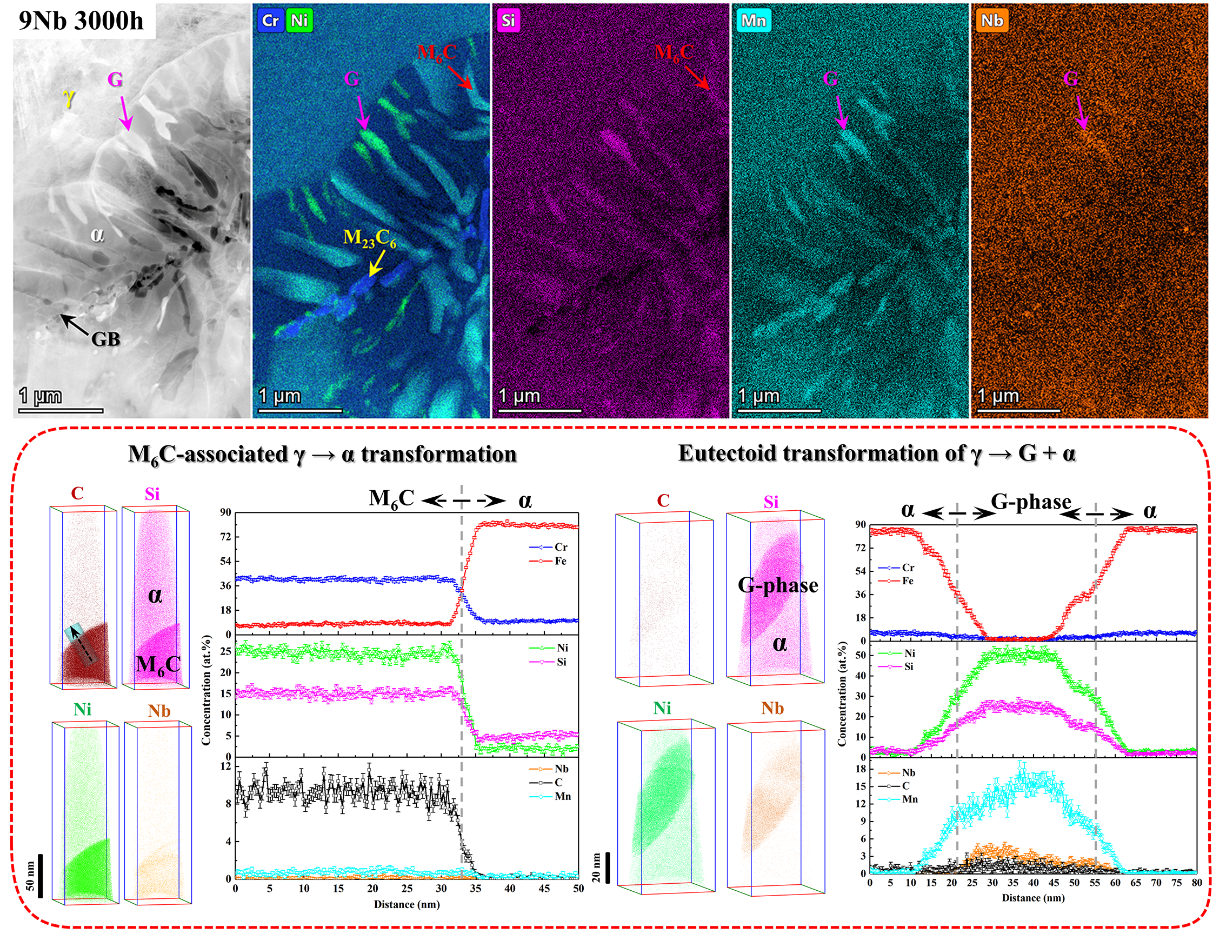
Nb partitioning-mediated austenite decomposition process. (Image by IMR)
<関連情報>
- https://english.cas.cn/newsroom/research-news/202609/t20260922_1201107.shtml
- https://www.sciencedirect.com/science/article/abs/pii/S1359645426008633
Si改質オーステナイト系ステンレス鋼における、550℃での長期熱時効中のニオブ分配を介したオーステナイト分解 Niobium partitioning-mediated austenite decomposition in a Si-modified austenitic stainless steel during long-term thermal aging at 550 °C
Ang Xie, Shenghu Chen, Zengbao Jiao, Lijian Rong
Acta Materials Available online: 11 September 2026
DOI:https://doi.org/10.1016/j.actamat.2026.122764
Abstract
Si-modified Fe-Cr-Ni austenitic steels exhibit superior corrosion resistance in liquid lead-bismuth eutectic coolant; however, their application is limited by Si-induced austenite decomposition at elevated temperatures. This decomposition arises from pronounced Si rejection during M23C6 precipitation, thereby creating a local chemical environment favorable for α-ferrite formation. Herein, Nb addition is introduced to regulate Si redistribution and modify the decomposition pathway during aging at 550 °C for up to 3000 h. Nb addition suppresses M23C6 precipitation through preferential NbC formation and promotes the formation of (Nb, Si)-rich clusters via strong Nb-Si interactions. The Nb-modified austenite decomposition proceeds via two distinct pathways: an M6C-associated γ → α-ferrite transformation at intermediate aging times (∼500 h) and a G-phase-mediated γ → G-phase + α-ferrite eutectoid transformation during prolonged aging. The (Nb, Si)-rich clusters act as chemically favorable precursors for M6C carbide and G-phase nucleation, while the partitioning of Nb and Si mainly governs the transformation kinetics. A stabilization treatment involving the formation of dispersed nanosized NbC further suppress decomposition by reducing the availability of C and Nb in the austenite matrix. These findings demonstrate that Nb addition effectively mitigates Si-induced austenite decomposition by altering precipitation sequences and local solute redistribution, providing a strategy for improving the long-term microstructural stability of Si-modified austenitic steels.