2026-09-16 マサチューセッツ工科大学(MIT)
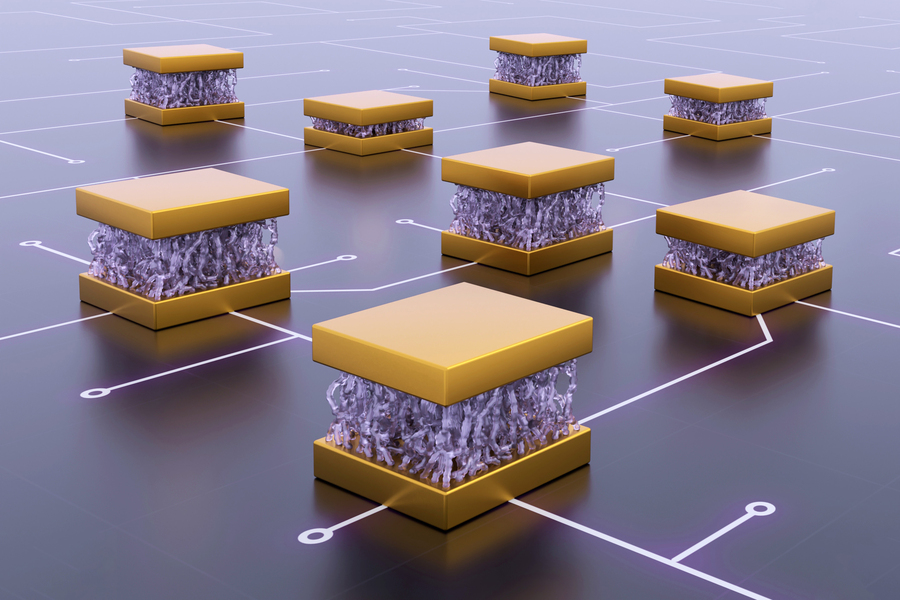
This illustration shows the nano-mechanical devices the researchers developed. Inspired by neurons, they can perform computing tasks with high energy efficiency. Credits: Image: Emily Theobald
<関連情報>
- https://news.mit.edu/2026/nanoscale-mechanics-could-enable-brain-inspired-computing-0916
- https://www.science.org/doi/10.1126/sciadv.aeg9893
ニューロモルフィック情報処理のための粘弾性ナノメカニカルデバイス Viscoelastic nanomechanical devices for neuromorphic information processing
Peter F. Satterthwaite, Sarah O. Spector, Maxwell Conte, Teddy Hsieh, […] , and Farnaz Nirou
Science Advances Published:16 Sep 2026
DOI:https://doi.org/10.1126/sciadv.aeg9893
Abstract
Information processing through intrinsic physical processes in materials enables energy-efficient, bioinspired computing paradigms. In particular, mechanical transformations at the nanoscale stand out as a versatile and efficient mechanism for sensitive and highly tunable control. Here, we introduce an in-material computing platform leveraging the mechanical properties of nanoscale soft matter. Overcoming the limitations of conventional mechanical systems, our platform enables subnanometer control and engineered dynamics, which we demonstrate in an electromechanically tunable tunneling junction composed of a nanometer-thin poly(dimethylsiloxane) film. In this device, voltage-induced reconfigurations translate into a nonlinear, time-dependent electrical response. We use these temporal dynamics, arising from the viscoelastic memory of the polymer, to demonstrate an artificial neuron. As neural functionalities are embedded within the intrinsic material properties, energy efficiencies beyond those of biological systems are projected with much smaller active areas. Overall, our work establishes a design framework for extremely scaled mechanical tunability, opening emerging applications in energy-efficient, bioinspired computing, and intelligent materials and systems.