2026-09-03 海洋研究開発機構
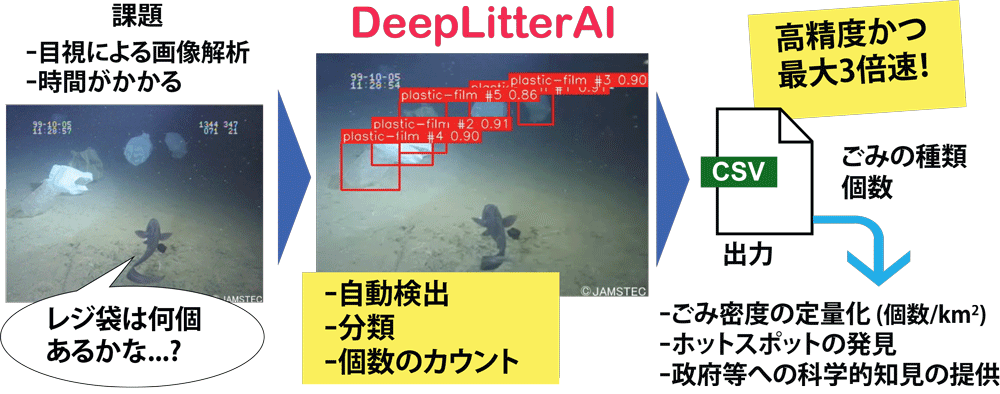
発表の図解要約
<関連情報>
- https://www.jamstec.go.jp/j/about/press_release/20260903/
- https://www.sciencedirect.com/science/article/pii/S0269749126013746
DeepLitterAI:日本近海におけるフィールド検証による深海底プラスチックおよび大型ゴミの自動検出と定量化 DeepLitterAI: Automated detection and quantification of deep-sea benthic plastic and macrolitter with field validation in waters around Japan
Ryota Nakajima, Takaki Nishio, Hideaki Saito, Shintaro Kawahara, Daisuke Matsuoka
Environmental Pollution Available online: 21 August 2026
DOI:https://doi.org/10.1016/j.envpol.2026.129004
Highlights
- DeepLitterAI automatically detects and counts deep-sea macrolitter.
- Small-object training improves detection under realistic survey conditions.
- Tracking enables category-specific counts without repeated counting.
- Field validation showed litter counts close to manual inspection.
- AI analysis was up to more than three times faster than manual work.
Abstract
Deep-sea imagery is a non-destructive tool for monitoring seafloor litter, but manual inspection limits its scalability. DeepLitterAI, a YOLOv11x-based detector combined with BoT-SORT tracking, was developed to automatically detect and quantify deep-sea benthic macrolitter. The model was trained with J-Litter, a dataset of 12,029 annotated images extracted from footage acquired by the Japan Agency for Marine-Earth Science and Technology (JAMSTEC) between 1983 and 2025. J-Litter includes small litter objects and non-litter images. DeepLitterAI was compared with a model trained only on large, clearly visible litter to evaluate training-data bias. On realistic test images containing small objects, DeepLitterAI achieved average precision (AP), which summarizes precision-recall performance, of 0.79-0.81 and F1 scores, defined as the harmonic mean of precision and recall, of 0.71-0.76 for plastic films, plastic bottles, and beverage cans (mean AP@0.5 = 0.80 and mean F1 = 0.73), with AP values averaging 1.6-fold higher than those of the large-object model. In six independent survey videos acquired at depths of 860-5641 m, using manual inspection as the reference, DeepLitterAI achieved F1 scores of 0.65-0.89, with a mean of 0.77 across categories. AI-derived total litter density averaged 1.1 times the manual estimate. AI analysis was 1.5-3.1 times faster than manual inspection, with a mean speed-up of 2.1-fold. Performance was robust to viewing angle, whereas false-negative rate increased to 25% under the highest synthetic turbidity condition. DeepLitterAI provides a scalable, non-destructive framework for standardized monitoring and mapping of deep-sea macrolitter.