2026-09-09 中国科学院(CAS)
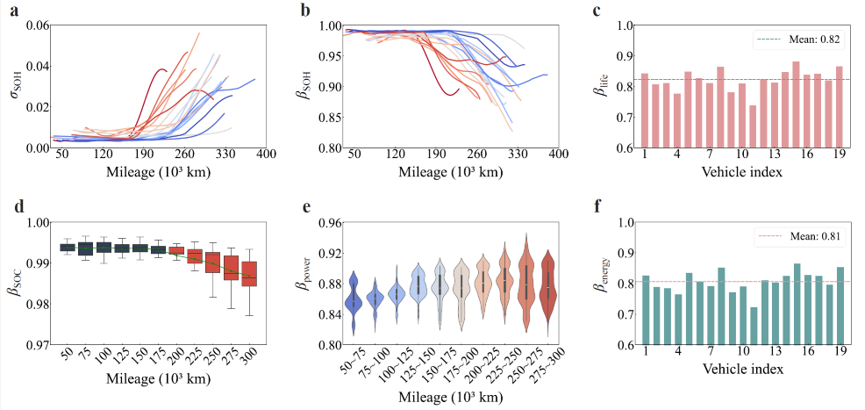
Quantitative evaluation of the impacts of cell-to-cell inconsistency on EV battery pack state of health, lifetime, state-of-charge utilization, power capability, and lifetime energy-resource utilization based on real-world operation data. (Image by ZHOU Litao)
<関連情報>
- https://english.cas.cn/newsroom/research-news/202609/t20260909_1195055.shtml
- https://www.nature.com/articles/s41560-026-02131-5
セル間のばらつきが電気自動車用バッテリーの劣化と利用に及ぼす影響の定量化 Quantifying the impact of cell-to-cell inconsistency on electric vehicle battery degradation and utilization
Litao Zhou,Xiaolei Bian,Yizhou Zhang,Zhenpo Wang,Zhongwei Chen,Zhiyu Mao & Changfu Zou
Nature Energy Published:25 August 2026
DOI:https://doi.org/10.1038/s41560-026-02131-5
Abstract
Enhancing utilization rates of battery systems in electric vehicles (EVs) substantially benefits economic efficiency and environmental sustainability. However, cell-to-cell inconsistency remains a critical barrier to fully realizing these advantages, and its system-level impact under real-world EV operation is still poorly quantified. Here we present a dataset containing 116 passenger cars and 17 buses, encompassing operational data spanning more than 3 years and up to 300,000 km per vehicle. Using practical measurements, we estimate individual cell capacity and resistance and construct a diagnostic framework of six metrics capturing variability in cell health, pack capacity retention, lifetime degradation, state-of-charge utilization, power capability and energy utilization. Our analysis reveals substantial performance degradation, including battery health reductions of 6.2% for passenger cars and 7.5% for buses, lifetime shortening by 17.7% and 22.8% and power capability decreases of 12.9% and 15.1%, respectively. Consequently, energy-resource utilization is limited to 80.7% for cars and 72.9% for buses over their operational lifespans. These findings underscore the necessity of consistency control for advancing EV battery technologies.