2026-09-09 中国科学院(CAS)
淡水保護区(FPA)では禁漁だけでは在来魚の生態系回復が進まない場合があることから、中国科学院水生生物研究所の研究チームは、特定魚類を選択的に除去する「標的魚類除去(TFR)」の効果を検証した。中国の5湖沼で2年間調査した結果、外来魚、放流魚、濾過摂食魚、底生魚などを対象としたTFRは、在来魚の分類学的・機能的多様性を高め、魚類―動物プランクトン―大型無脊椎動物―植物プランクトン間の栄養関係にも影響を与えた。植物プランクトン量の減少と水透明度の向上も確認された。一方、効果は湖沼や除去対象によって異なり、外来種の増加を招くケースもあった。したがって、禁漁を一律に適用するのではなく、外来種侵入、過剰放流、底生攪乱など地域特性を踏まえた適応的・能動的管理を組み合わせることが重要だと示された。
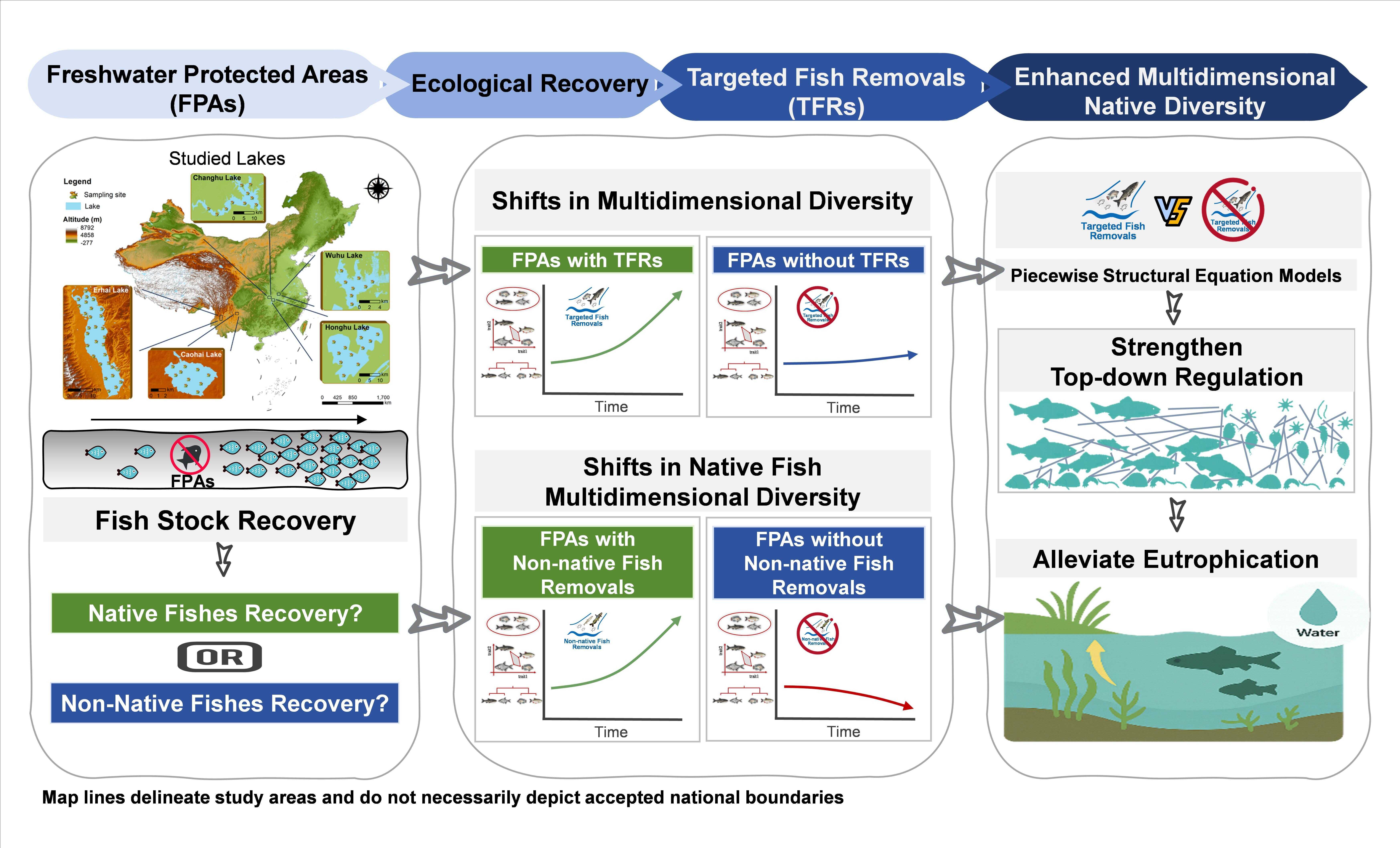
Effects of targeted fish removals on lake fish diversity recovery and ecosystem functioning. (Image by IHB)
<関連情報>
- https://english.cas.cn/newsroom/research-news/202609/t20260909_1195091.shtml
- https://besjournals.onlinelibrary.wiley.com/doi/10.1111/1365-2664.70521
淡水保護区域における魚類の集中的な駆除は、在来魚の多次元的な多様性を高める Targeted fish removals enhance multidimensional native fish diversity within freshwater protected areas
Zhice Liang, Andrew L. Rypel, Jiashou Liu, Chuanbo Guo
Journal of Applied Ecology Published: 03 August 2026
DOI:https://doi.org/10.1111/1365-2664.70521
Abstract
- Freshwater ecosystems are hotspots of biodiversity and contribute significantly to food security. Yet freshwater habitats throughout the world remain plagued by overfishing, which depletes populations and diminishes provisioning of ecosystem services. There is growing interest in the use of freshwater protected areas (FPAs), which are freshwater ecosystems managed under long-term fishing bans and conservation-oriented regulations, to promote ecosystem recovery. Yet empirical evidence on the efficacy of FPAs indicates that ecological recovery can be complicated by non-native species, which may also benefit from reduced harvest pressure and improved habitat conditions.
- To evaluate effects of targeted fish removals (TFRs) under fully implemented FPAs, we conducted exhaustive field surveys across five Chinese lakes with and without removal efforts and assessed multiple dimensions of fish assemblage diversity.
- Results showed multidimensional diversity metrics for native fishes improved significantly in FPAs with TFRs (e.g. non-native fish removals in invasion hotspots), while these same metrics declined in control lakes. Moreover, TFRs appeared to strengthen top-down regulation and alleviate eutrophication, as indicated by altered trophic cascade relationships and reduced phytoplankton biomass (PB) in FPAs with TFR.
- Synthesis and applications. Our results indicate combining FPAs with TFRs is essential to achieve effective biodiversity recovery in these ecosystems. This integrated strategy should be prioritized in invasion-prone or eutrophic systems, where passive protection alone is unlikely to deliver desired ecological outcomes.