2026-11-12 中国科学院(CAS)
大質量星の形成領域に存在する高密度コアの構造と進化段階を明らかにした研究である。中国科学院新疆天文台の研究チームは、アルマ望遠鏡(ALMA)による波長1.3 mmの観測データを用いて、地球から約3.4 kpc離れた大質量星形成領域G40.282−0.219を解析し、同一の母体ガス塊の内部に3つの高密度コア(MM1、MM2、MM3)を識別した。質量はそれぞれ約24.6、8.4、5.2太陽質量であり、質量だけでは進化段階を判断できないことが示された。MM1は分子スペクトル線が少なく、アウトフローも検出されない最も若い段階にある。一方、MM2では秒速約25 kmの一酸化ケイ素ジェットが確認され、MM3では高いダスト温度、多様な分子、6.7 GHzメタノールメーザーが観測された。これらの結果から、同じ星形成領域内でもコアごとに物理化学的性質と進化段階が異なることが明らかになった。本研究は、質量、密度、温度、分子組成、ジェットやメーザーなど複数の観測指標を組み合わせることで、大質量星形成の進化過程をより正確に理解できることを示している。
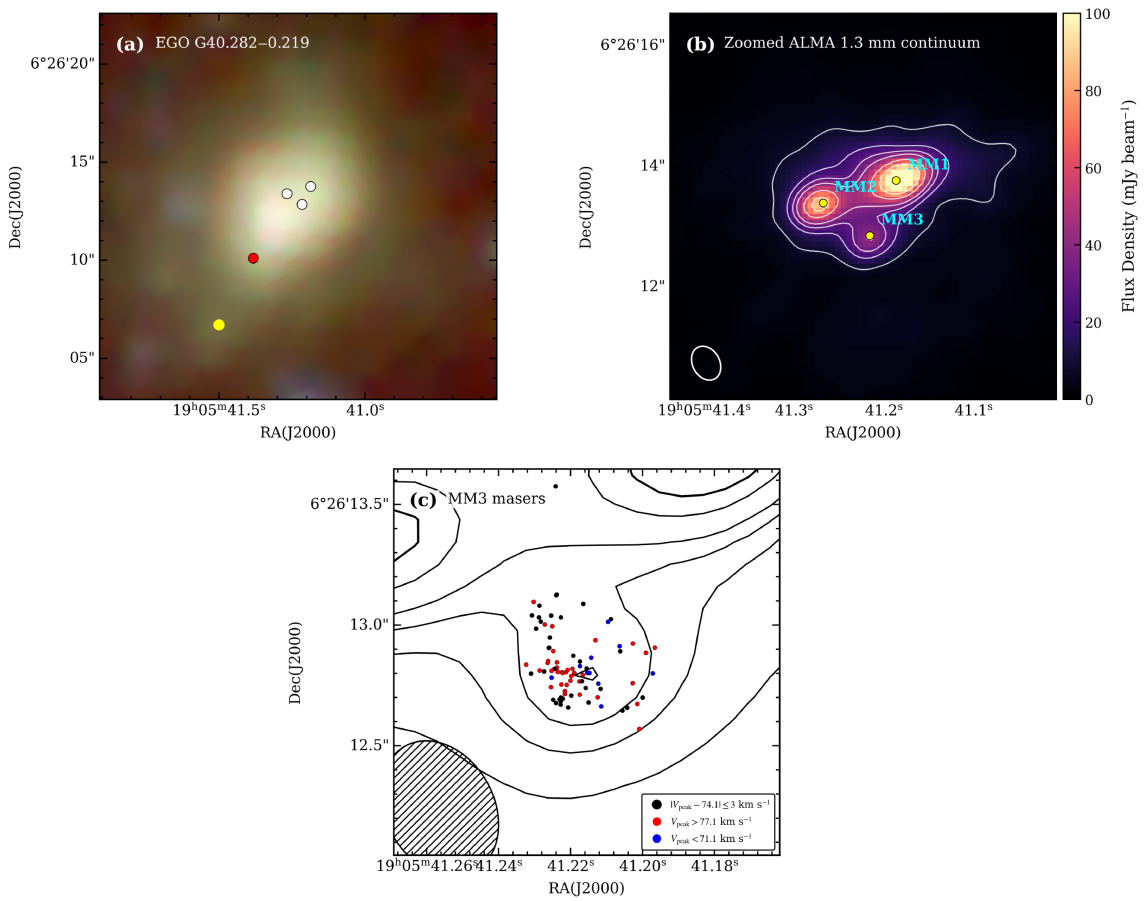
The G40.282−0.219 region seen by Spitzer (a), the three compact cores resolved by ALMA at 1.3 mm (b), and the methanol masers concentrated around MM3 (c). (Image by XAO)
<関連情報>
- https://english.cas.cn/newsroom/research-news/202611/t20261112_1218926.shtml
- https://iopscience.iop.org/article/10.3847/1538-4357/aea6ad
G40.282−0.219大質量若年星天体クラスターにおけるミリ波コンパクト放射、メーザーおよびアウトフロー活動の相違
(Distinguishing between the Strongest Millimeter Compact Emission and Maser and Outflow Activities in the G40.282–0.219 Massive Young Stellar Object Cluster)
A. G. Tegegne, Jarken Esimbek, Andrey M. Sobolev, Sergey Yu Parfenov, Dmitry A. Ladeyschikov, Gang Wu, Sheng Yuan Liu, Yu Nung Su, Jianjun Zhou, Dalei Li, Xindi Tang, Yuxin He, Toktarkhan Komesh, Dongdong Zhou, Yingxiu Ma, Kadirya Tursun, Dilda Berdikhan, Jinjin Xie, Qaynar Jandaolet, Nurzhan Shaimoldin, Abay Jengis
The Astrophysical Journal, 1011(1), Article 33 2026-11-01
DOI:https://doi.org/10.3847/1538-4357/aea6ad
Tii-summary
大質量星形成領域では、若い星の周囲に形成される高密度ガス塊の進化や化学的特徴を理解することが重要である。本研究では、G40.282−0.219領域を対象に、アルマ望遠鏡(ALMA)による波長1.3 mmの連続波観測と13種類の分子輝線観測を実施し、星形成領域を構成する3つのコンパクトなコアの物理的・化学的特徴を調べた。その結果、最も強い連続波放射を示すMM1は化学的に比較的乏しい一方、MM2では一酸化ケイ素(SiO)ジェットを伴う強力なアウトフローが確認された。また、連続波放射が最も弱いMM3には、6.7 GHzメタノールメーザーや複雑な有機分子が豊富に存在し、最も高いダスト温度を示すことが分かった。これらの結果は、ミリ波連続波の強度と分子化学的な豊かさ、アウトフローやメーザー活動が必ずしも一致しないことを示している。研究チームは、局所的な加熱、降着に伴う光度、進化段階が化学的特徴を左右する重要な要因であり、同一のガス塊内部でも異なる進化段階の大質量若年星が共存する可能性を示した。
Understanding the evolution and chemical properties of dense gas cores surrounding young stars is essential for studying massive star formation. In this study, the researchers investigated the star-forming region G40.282−0.219 using ALMA observations of 1.3 mm continuum emission and 13 molecular transitions to characterize three compact cores. The results revealed substantial differences among the cores. MM1 exhibits the strongest continuum emission but relatively poor chemical complexity, whereas MM2 drives a powerful molecular outflow traced by a silicon monoxide (SiO) jet. In contrast, MM3, despite having the weakest continuum emission, hosts Class II 6.7 GHz methanol masers, the richest molecular inventory, including complex organic molecules, and the highest dust temperature. These findings demonstrate that millimeter continuum brightness does not necessarily correlate with chemical richness, outflow activity, or maser emission. The researchers suggest that localized heating, accretion luminosity, and evolutionary stage are more important factors governing the observable chemical properties of massive young stellar objects. The three cores may represent different evolutionary stages within a single fragmenting natal clump.
Understanding the evolution and chemical properties of dense gas cores surrounding young stars is essential for studying massive star formation. In this study, the researchers investigated the star-forming region G40.282−0.219 using ALMA observations of 1.3 mm continuum emission and 13 molecular transitions to characterize three compact cores. The results revealed substantial differences among the cores. MM1 exhibits the strongest continuum emission but relatively poor chemical complexity, whereas MM2 drives a powerful molecular outflow traced by a silicon monoxide (SiO) jet. In contrast, MM3, despite having the weakest continuum emission, hosts Class II 6.7 GHz methanol masers, the richest molecular inventory, including complex organic molecules, and the highest dust temperature. These findings demonstrate that millimeter continuum brightness does not necessarily correlate with chemical richness, outflow activity, or maser emission. The researchers suggest that localized heating, accretion luminosity, and evolutionary stage are more important factors governing the observable chemical properties of massive young stellar objects. The three cores may represent different evolutionary stages within a single fragmenting natal clump.
出典:The Astrophysical Journal(2026年11月1日公開)