2026-09-01 東北大学
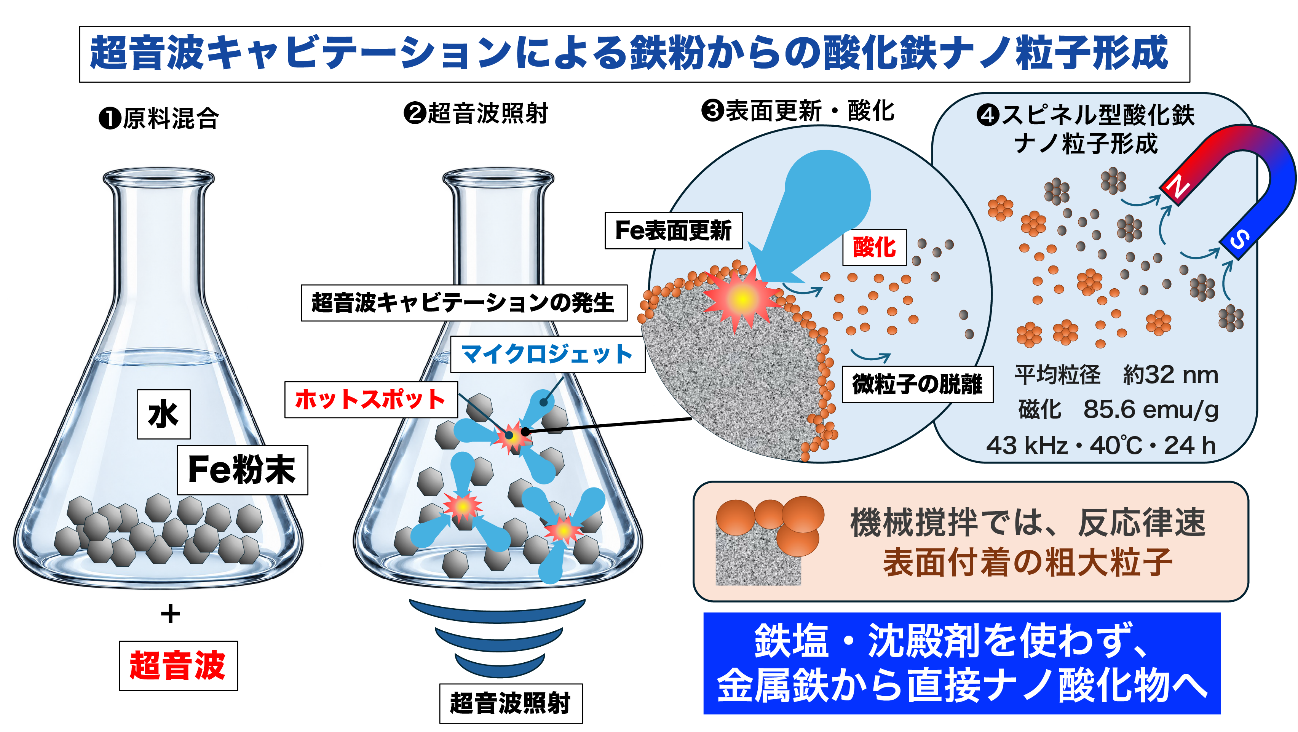
図1. 超音波キャビテーションによる鉄粉から酸化鉄ナノ粒子への直接変換
<関連情報>
- https://www.tohoku.ac.jp/japanese/2026/09/press20260901-03-sonochemical.html
- https://www.sciencedirect.com/science/article/pii/S1350417726002932
音響キャビテーションによって促進される鉄粉と水からの試薬不要の酸化鉄ナノ粒子の超音波化学合成 Reagent-free sonochemical synthesis of iron oxide nanoparticles from iron powder and water promoted by acoustic cavitation
Madoka Yoshikawa, Hirotsugu Takizawa, Yamato Hayashi
Ultrasonics Sonochemistry Available online: 25 August 2026
DOI:https://doi.org/10.1016/j.ultsonch.2026.108028
Abstract
This study demonstrates a distinct reagent-free sonochemical route in which acoustic cavitation directly converts elemental Fe powder into spinel-type iron oxide nanoparticles in water at near-ambient temperatures, without soluble Fe precursors, precipitating agents, or other added reagents. At 43 kHz and 40 °C for 24 h, the obtained particles exhibited a mean diameter of 32 nm and a magnetization of 85.6 emu/g at the maximum applied field. Under otherwise identical conditions at 60 °C, particles with a mean diameter of 33 nm and a magnetization of 76.9 emu/g were obtained. The difference in magnetization may reflect changes in the Fe2+/Fe3+ balance and/or nanoscale magnetic effects, although the phase composition could not be determined quantitatively from the present measurements. Based on the observed morphologies and phase evolution, nanoparticle formation is proposed to involve both homogeneous nucleation from dissolved Fe species and heterogeneous oxidation on the bulk Fe surface. In contrast, mechanical stirring induced Fe oxidation but produced submicrometer-sized particles attached to the Fe surface. Acoustic cavitation may disrupt the surface oxide layer, expose fresh Fe interfaces, and thereby promote the formation and detachment of fine particles. These findings demonstrate acoustic-cavitation-assisted direct metal-to-oxide conversion as a synthesis pathway distinct from conventional iron-salt-based precipitation, while avoiding soluble Fe precursors and precipitating agents.