2026-09-01 東北大学
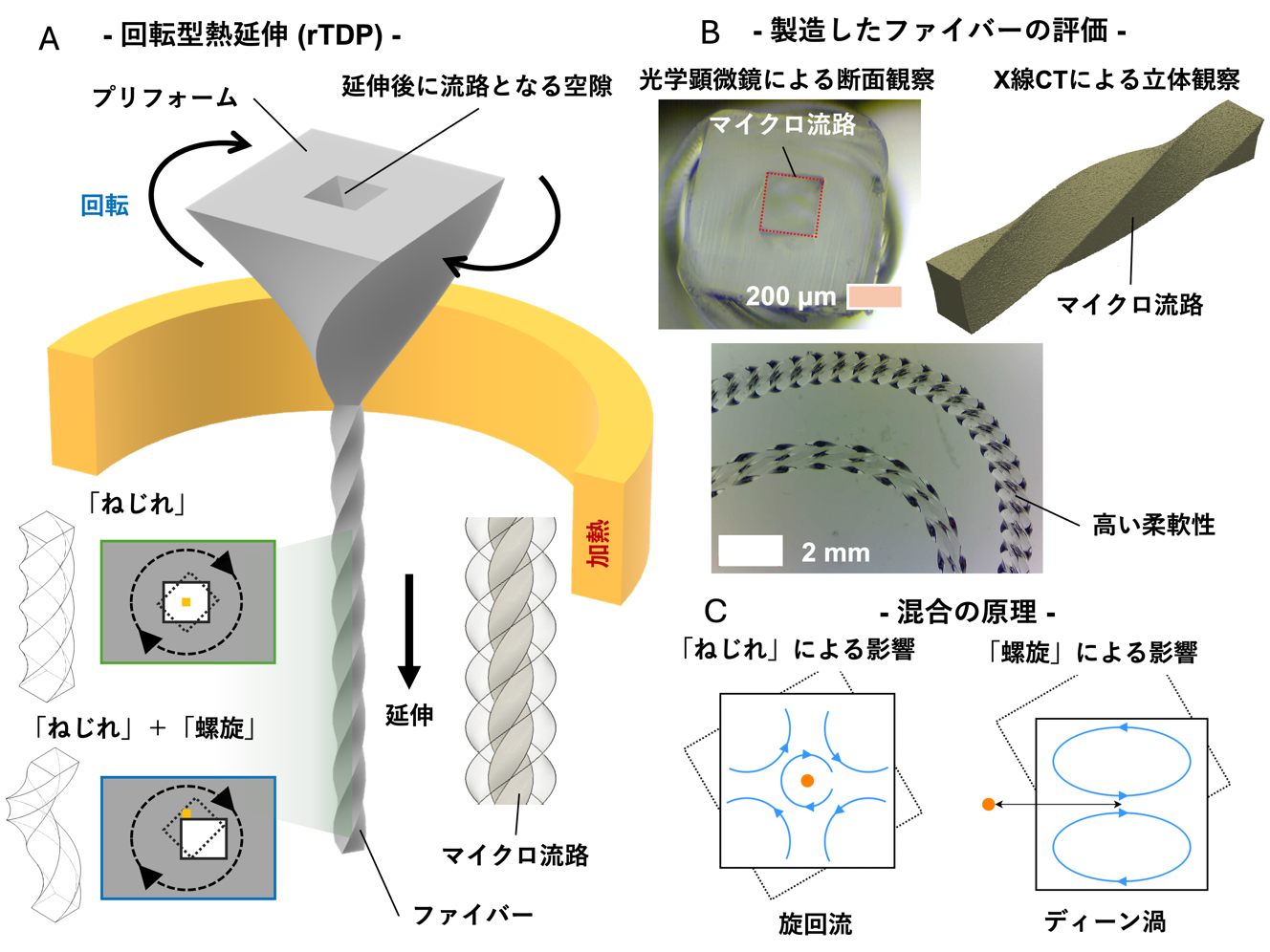
図1. 熱延伸技術により、「ねじれ型」のマイクロ流路を備えたポリマー製ファイバーを製造した。
A)延伸中に回転を加えることで、ねじれパターンを生成する。
B)マイクロ流路は製造誤差が小さい。また、ファイバーは高い伸縮性を持つ。
C)「ねじれ」により旋回流が、「螺旋」によりディーン渦が発生する。
<関連情報>
- https://www.tohoku.ac.jp/japanese/2026/09/press20260901-02-drawing.html
- https://pubs.acs.org/aamick/article/doi/10.1021/acsami.6c06952/5385082/Programmable-Twisted-Microchannels-in-Polymer
回転熱延伸によるポリマー繊維中のプログラム可能なねじれマイクロチャネルによるマイクロミキシングの強化 Programmable Twisted Microchannels in Polymer Fibers via Rotational Thermal Drawing for Enhanced Micromixing
Shunsuke Kato;Danessia Zan;To-En Hsu;Ricardo Arturo Lopez de la Cruz;Tomoki Saizaki;Jérôme Adrien;Eric Maire;Amy Q. Shen;Yuanyuan Guo
ACS Applied Materials & Interfaces Published:August 31, 2026
DOI:https://doi.org/10.1021/acsami.6c06952
Abstract
Micromixers are essential components of microfluidic systems, enabling rapid and homogeneous mixing at microliter and submicroliter scales. Although three-dimensional (3D) microchannel geometries can significantly enhance mixing performance, their broader adoption has been limited by fabrication challenges that restrict geometric control, scalability, and system integration. Here, we report an in-fiber twisted micromixer, termed the Fiber-μMixer, fabricated by rotational thermal drawing (rTDP). By introducing controlled rotation and revolution during drawing, this method enables scalable fabrication of microchannels with centered and off-centered geometries, feature sizes down to 100 μm, and twist pitches as small as 4 mm. The resulting twisted and helical channel architectures enhance microscale mixing through the combined effects of swirl-induced advection and Dean-vortex-driven secondary flows. Numerical simulations and experiments demonstrate strong mixing performance across a range of Reynolds numbers, with mixing efficiencies exceeding 75% and negligible pressure penalty in the intermediate regime (1 ≤ Re ≤ 30), where conventional passive micromixers typically underperform. This in-fiber micromixing platform provides a practical and scalable route toward compact, flexible, and multifunctional microfluidic systems, opening opportunities for lab-in-fiber technologies and advanced microscale fluid handling.