2026-08-27 スイス連邦工科大学ローザンヌ校(EPFL)

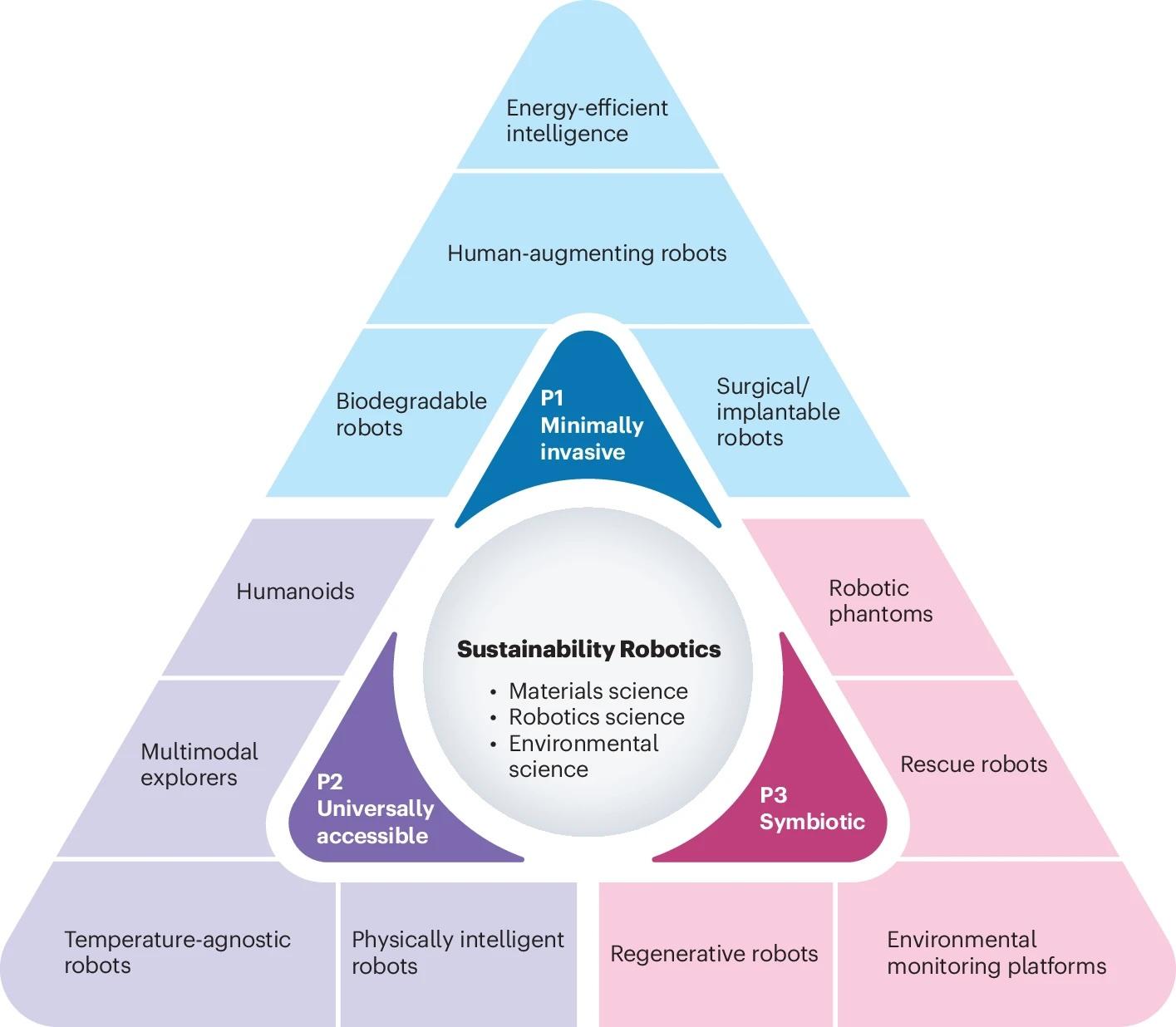
The three core principles of Sustainability Robotics. 2026 LSR/EPFL – CC BY SA 4.0
<関連情報>
- https://actu.epfl.ch/news/reimagining-robotics-for-sustainability-2/
- https://tiisys.com/blog/2025/05/09/post-166734/
- https://www.nature.com/articles/s42256-026-01260-6
- https://link.springer.com/article/10.1007/s41693-026-00201-4
- https://www.science.org/doi/10.1126/science.adx2444
- https://www.nature.com/articles/s42256-025-00988-x
- https://www.annualreviews.org/content/journals/10.1146/annurev-control-080122-090049
- https://ieeexplore.ieee.org/document/7778700
持続可能なロボティクスのためのマニフェスト A manifesto for Sustainability Robotics
S. Song,B. Mazzolai & M. Kovač
Nature Machine Intelligence Published:13 July 2026
DOI:https://doi.org/10.1038/s42256-026-01260-6
Abstract
Sustainability spans environmental, societal and economic challenges, from climate change to healthcare and education. Robotics holds substantial promise for addressing these issues, yet current developments remain fragmented and lack a unifying framework. This fragmentation risks unintended consequences, including unequal access to technology and missed opportunities for broader impact. Here we advocate for a new discipline, Sustainability Robotics, structured around three guiding principles: robots should be minimally invasive, reducing disruption to ecosystems and socio-economic systems; universally accessible, extending benefits to underserved communities and extreme environments; and symbiotic, generating mutually beneficial outcomes for humans and nature. We define two complementary dimensions. The first, sustainable robot design, focuses on minimizing environmental impact through materials, energy and manufacturing. The second, robotic solutions for sustainability, leverages robotics to address environmental, social and economic challenges. By integrating perspectives from science, engineering, economics, ethics and policy, Sustainability Robotics provides a foundation for coordinated research, education and innovation. This framework aims to align robotics development with global sustainability goals, enabling more equitable and effective technological impact.
人間とロボットの相互作用を通じて、不規則な端材から構造用木材トラスを製作する Crafting structural timber trusses from irregular offcuts via human–robot interaction
Eleni Skevaki,Eric Duong,Hong-Bin Yang & Stefana Parascho
Construction Robotics Published:03 July 2026
DOI:https://doi.org/10.1007/s41693-026-00201-4
Abstract
Working with irregular, reclaimed, and non-standard materials is essential to reducing the environmental impact of construction. Yet most robotic design-to-fabrication workflows rely on uniform components and predefined plans. This disconnect reflects a missed opportunity: material uncertainty, rather than being treated as a constraint, can become a catalyst for creativity when made actionable through well-designed human–robot interfaces. Building on the Truss from Trash framework, this paper presents an extended human–robot system for the adaptive assembly of timber trusses from offcuts. A projection-based interface embeds interaction within the fabrication environment, allowing users to select materials and adjust the design using tangible tokens, while real-time overlays provide member assignment guidance and cut previews. An on-demand form-finding component supports decision-making by validating equilibrium for user edits and proposing feasible design adaptations based on available stock. Validated changes propagate to the robot, which executes pick-cut-place cycles to incrementally assemble the structure. Through fabrication experiments, we show how our system enables users to reconcile material availability, design intent, and structural feasibility alongside fabrication.
環境の持続可能性のためのロボットの設計と活用 Designing and using robots for environmental sustainability
Aude G. Billard
Science Published:17 Apr 2025
DOI:https://doi.org/10.1126/science.adx2444
If you were to ask a random passerby to describe what a robot is made of and how it is powered, they would likely tell you that a robot is made of metal and requires electricity to operate. Experts, however, would likely say that robotic control systems consist of electronic boards connected to a variety of sensors—from light detection and ranging (LIDAR) sensors to cameras to electronic skins—and that current power sources range from standard electric batteries to hydraulic pumps.
At first glance, the relationship between robots and environmental sustainability may not be obvious. But the connection lies in part in the experts’ understanding of how a robot is made and how it works. Roboticists must increasingly consider the fact that the generation of electricity still largely relies on unsustainable energy sources and that manufacturing sensors and electronic boards requires the extraction of rare earth materials.
Nevertheless, robots also have the potential to help contribute to societal sustainability goals. Current research on this topic follows two main paths: creating robots that facilitate a more sustainable use of resources and creating robots that are themselves more sustainable.
シナジーベースのロボット四足歩行ロボット:受動性を活用した自然知能と行動の多様性 Synergy-based robotic quadruped leveraging passivity for natural intelligence and behavioural diversity
Francesco Stella,Mickaël M. Achkar,Cosimo Della Santina & Josie Hughes
Nature Machine Intelligence Published:17 March 2025
DOI:https://doi.org/10.1038/s42256-025-00988-x
Abstract
Quadrupedal animals show remarkable capabilities in traversing diverse terrains and display a range of behaviours and gait patterns. Achieving similar performance by exploiting the natural dynamics of the system is a key goal for robotics researchers. Here we show a bioinspired approach to the design of quadrupeds that seeks to exploit the body and the passive properties of the robot while maintaining active controllability on the system through minimal actuation. Utilizing an end-to-end computational design pipeline, neuromechanical couplings recorded in biological quadrupeds are translated into motor synergies, allowing minimal actuation to control the full structure via multijoint compliant mechanical couplings. Using this approach, we develop PAWS, a passive automata with synergies. By leveraging the principles of motor synergies, the design incorporates variable stiffness, anatomical insights and self-organization to simplify control while maximizing its capabilities. The resulting synergy-based quadruped requires only four actuators and exhibits emergent, animal-like dynamical responses, including passive robustness to environmental perturbations and a wide range of actuated behaviours. The finding contributes to the development of machine physical intelligence and provides robots with more efficient and natural-looking robotic locomotion by combining synergistic actuation, compliant body properties and embodied compensatory strategies.
建設ロボット:自動化から協働へ Construction Robotics: From Automation to Collaboration
Stefana Parascho
Annual Review of Control, Robotics, and Autonomous Systems 6:183-204. 2023 Published:November 28, 2022
DOI:https://doi.org/10.1146/annurev-control-080122-090049
ABSTRACT
Over the past decades, robotics has shown great potential to impact the built environment, from automation to differentiation and efficient construction. However, construction processes are highly complex and require tackling a multitude of problems, from safety and robustness to ease of control and interactivity. For this reason, the field of construction robotics is still evolving, requiring finding solutions for new challenges every day. The present review analyzes the role of robotics in construction and architecture over time and highlights current trends in shifting from pure automation toward collaborative and adaptive processes that have the potential to fully integrate robotics into a rigid and challenging industry, such as construction.
エンバイロボット:生物にヒントを得た環境モニタリングプラットフォーム Envirobot: A bio-inspired environmental monitoring platform
Behzad Bayat; Alessandro Crespi; Auke Ijspeert
2016 IEEE/OES Autonomous Underwater Vehicles Date Added to IEEE Xplore: 12 December 2016
DOI:https://doi.org/10.1109/AUV.2016.7778700
Abstract
Autonomous marine vehicles are becoming essential tools in aquatic environmental monitoring systems, and can be used for instance for data acquisition, remote sensing, and mapping of the spatial extent of pollutant spills. In this work, we present an unconventional bio-inspired autonomous robot aimed for execution of such tasks. The Envirobot platform is based on our existing segmented anguilliform swimming robots, but with important adaptations in terms of energy use and efficiency, control, navigation, and communication possibilities. To this end, Envirobot has been designed to have more endurance, flexible computational power, long range communication link, and versatile flexible environmental sensor integration. Its low level control is powered by an ARM processor in the head unit and micro processors in each active module. On top of this, integration of a computer-on-module enables versatile high level control methods. We present some preliminary results and experiments done with Envirobot to test the added navigation and control strategies.