2026-07-23 東京科学大学
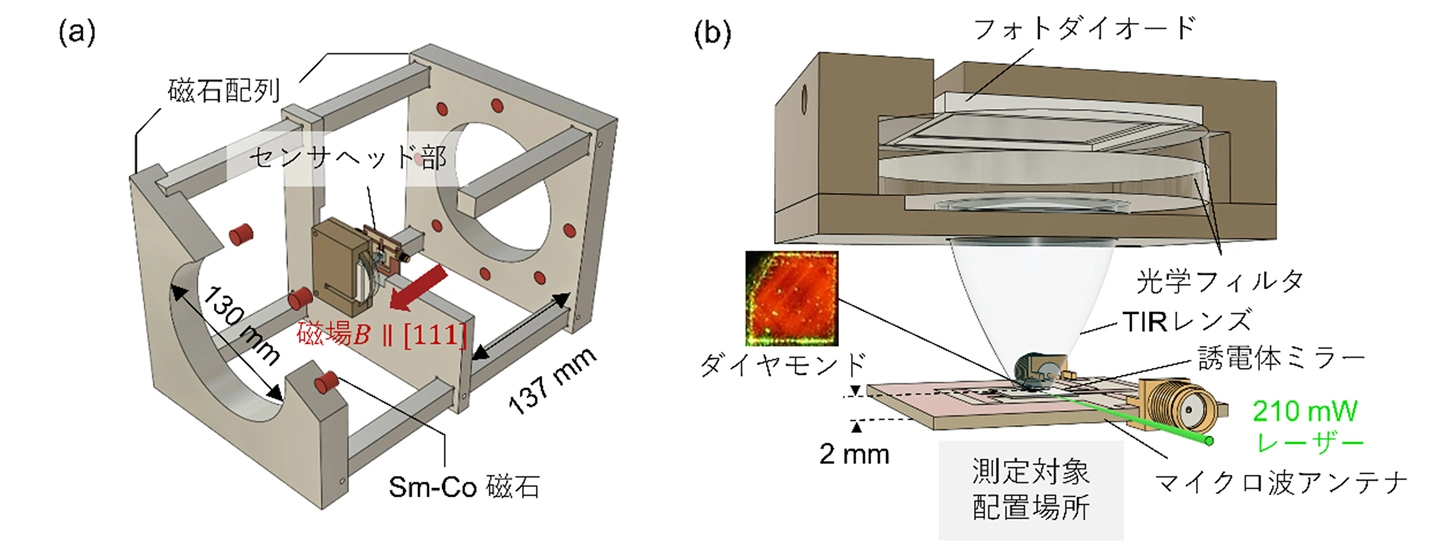
図1. (a)磁石アレイを含むダイヤモンド量子センサ全体図。(b)センサヘッドの拡大図。
<関連情報>
- https://www.isct.ac.jp/ja/news/gdo2l20y7ks4
- https://pubs.aip.org/aip/apl/article-abstract/129/3/034003/3399057/A-highly-sensitive-diamond-NV-magnetometer-using
- https://pubs.aip.org/aip/sci/article/2026/30/301109/3399028/Highly-sensitive-magnetometer-boosts-biomagnetic
ラムゼイ干渉法を用いた高感度ダイヤモンドNV磁力計(センサーとサンプル間の距離が短い) A highly sensitive diamond NV magnetometer using Ramsey interferometry with a short sensor-to-sample distance
Yuta Araki;Takeharu Sekiguchi;Yuji Hatano;Naota Sekiguchi;Chikara Shinei;Masashi Miyakawa;Takashi Taniguchi;Tokuyuki Teraji;Hiroshi Abe;Shinobu Onoda;Takeshi Ohshima;Takayuki Shibata;Mutsuko Hatano;Takayuki Iwasaki
Applied Physics Letters Published:July 22 2026
DOI:https://doi.org/10.1063/5.0334709
In this study, we developed a diamond quantum magnetometer based on Ramsey interferometry with a short sensor-to-sample distance. Conventional biomagnetic sensors with ensemble nitrogen-vacancy centers using continuous-wave optically detected magnetic resonance and Ramsey methods typically rely on watt-level lasers to achieve high sensitivity, resulting in thermal issues. In contrast, by employing the light-trapping diamond waveguide technique in a high-pressure and high-temperature diamond sample treated with electron beam irradiation, we obtained a high optical power conversion efficiency of 9.5%, enabling us to simultaneously achieve a high sensitivity of 2.93(7) in the 100–400 Hz frequency range and a minimal temperature increase of only approximately 13 K at a low laser power of 210 mW. Using a dry phantom designed to mimic magnetoencephalography signals, we measured a weak magnetic field of 77.7(2) pT without signal averaging at a sensor-to-sample distance of 2.5 mm. This short distance measurement prevents severe spatial signal attenuation, yielding a high signal-to-noise ratio. The development here is crucial for practical biomagnetic applications based on Ramsey interferometry.
高感度磁力計は、センサーとサンプル間の距離を縮めることで生体磁気センシングを向上させる Highly sensitive magnetometer boosts biomagnetic sensing by closing sensor-to-sample distance
Adam Liebendorfer
Scilight Published:July 22 2026
DOI:https://doi.org/10.1063/10.0044530
Detecting biomagnetic fields, such as in magnetoencephalography — a technique for understanding pathologies such as seizures — has remained a challenge for researchers due to steep signal decays with distance. Diamond quantum sensors are uniquely suited to minimize this sensor-to-sample distance.
Araki et al. developed a highly sensitive Ramsey-based ensemble magnetometer for biomagnetic field sensing. Utilizing a printed-circuit-board microwave antenna, the group’s device shortens the sensor-to-sample distance to 2 millimeters, achieving an effective detection capability directly from the source previously unattainable by conventional high-power approaches.
The device marks a departure from conventional sensors, where high-power laser-based approaches create thermal issues in samples.
“The true innovation of our work lies in a conceptual shift: moving away from simply chasing absolute sensitivity, which typically requires high thermal loads, to optimizing the effective signal-to-noise ratio in a practical, close-proximity geometry,” said author Takayuki Iwasaki. “By demonstrating how to overcome the thermal barriers of pulsed protocols, we hope this paper paves the way for a broader transition in the field from conventional continuous-wave optically detected magnetic resonance methods to more advanced, Ramsey-based biomagnetic sensors.”
Comparable Ramsey applications have achieved a 6.5-millimeter sensor-to-sample distance.
The device employed a waveguide technique that trapped light in high-pressure, high-temperature diamond samples treated with electron beam radiation, housing nitrogen-vacancy centers, which boosted the device’s photon conversion efficiency to 9.5%
The new magnetometer detects magnetic fields as weak as 77.7 picoteslas, maintaining a minimal temperature increase of 13 K and an average sensor-to-sample distance of 2.5 millimeters, boosting the signal-to-noise ratio.
To maintain a high sensitivity during extended biomagnetic field measurements, the group next plans to implement active microwave feedback that dynamically tracks and cancels ambient temperature drift.
Source: “A highly sensitive diamond NV magnetometer using Ramsey interferometry with a short sensor-to-sample distance,” by Yuta Araki, Takeharu Sekiguchi, Yuji Hatano, Naota Sekiguchi, Chikara Shinei, Masashi Miyakawa, Takashi Taniguchi, Tokuyuki Teraji, Hiroshi Abe, Shinobu Onoda, Takeshi Ohshima, Takayuki Shibata, Mutsuko Hatano, and Takayuki Iwasaki, Applied Physics Letters (2026). The article can be accessed at https://doi.org/10.1063/5.0334709.