2026-07-01 中国科学院(CAS)
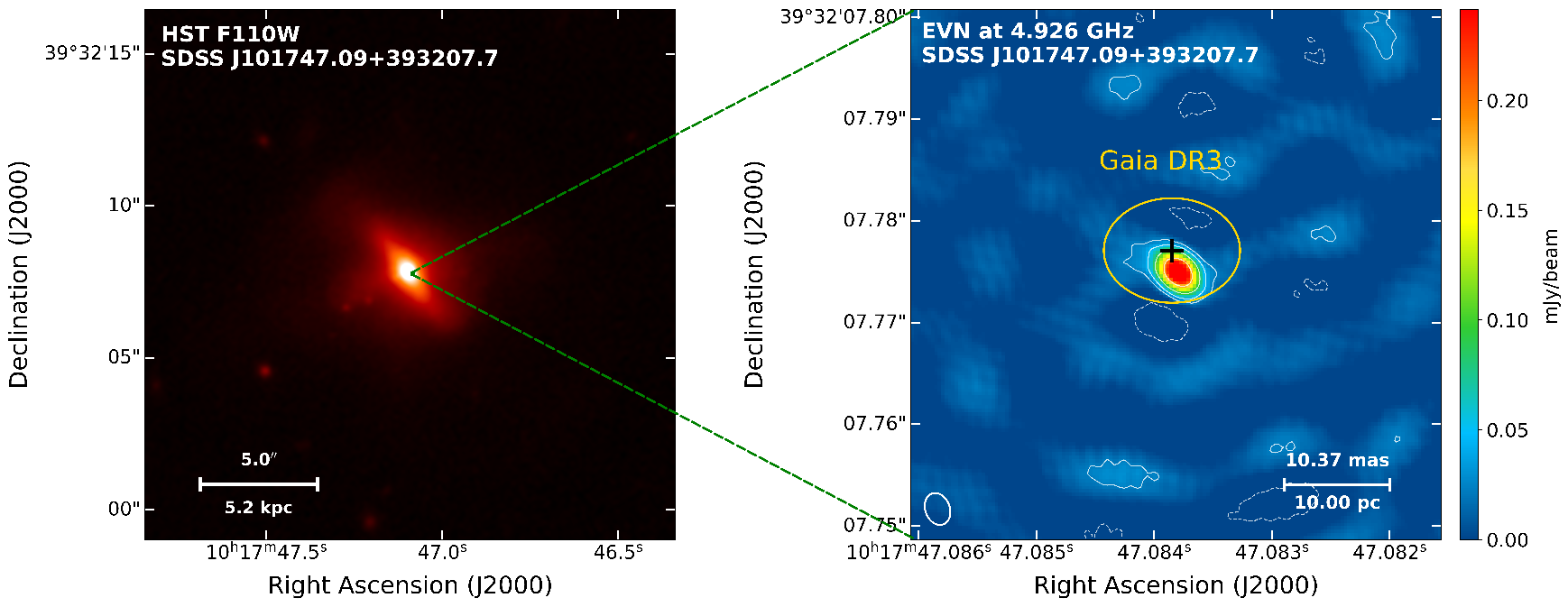
Left: HST imaging of RGG66 with the F110W infrared filter. Right: EVN image of RGG66 at 4.926 GHz. The black cross marks the optical position from Gaia DR3; the semi-major and semi-minor axes of the yellow ellipse represent the total 1σ uncertainties. (Image by XAO)
<関連情報>
- https://english.cas.cn/newsroom/research-news/202607/t20260701_1175181.shtml
- https://www.aanda.org/articles/aa/full_html/2026/06/aa60407-26/aa60407-26.html
降着円盤を持つ巨大ブラックホールから放出された、パーセク規模のコンパクトで減衰していく噴出物の検出 Detection of a parsec-scale, compact, and fading ejecta from an accreting massive black hole
Chao Li, Ning Chang, Jun Yang, Lang Cui and Luis C. Ho
Astronomy & Astrophysics Published:16 June 2026
DOI:https://doi.org/10.1051/0004-6361/202660407
Abstract
Dwarf galaxies, characterized by their low luminosities and masses, are excellent candidates for searches for intermediate-mass black holes (IMBHs), particularly when they show strong accretion and ejection activity. The dwarf galaxy SDSS J101747.09+393207.7 has recently been found to display a very high X-ray luminosity and an X-shaped optical structure, possibly caused by a dwarf–dwarf merger. To explore its potential IMBH ejection activity, we performed very long baseline interferometry (VLBI) observations at 4.9 GHz. In this work, we present the detection of a milliarcsecond-scale, compact, sub-microjansky radio component near the optical centroid. According to some existing radio sky survey data, the radio component was not detected until 2015; it displayed an optically thin steep radio spectrum and declining flux densities across 0.8–5 GHz from 2019 to 2025. Therefore, we identify it as a short-lived and rarely seen ejecta that was produced by unstable accretion onto a massive black hole and likely faded away in a few decades. These results indicate that short-lived, episodic jet activity from accreting IMBHs in dwarf galaxies might exist.