2026-07-01 中国科学院(CAS)
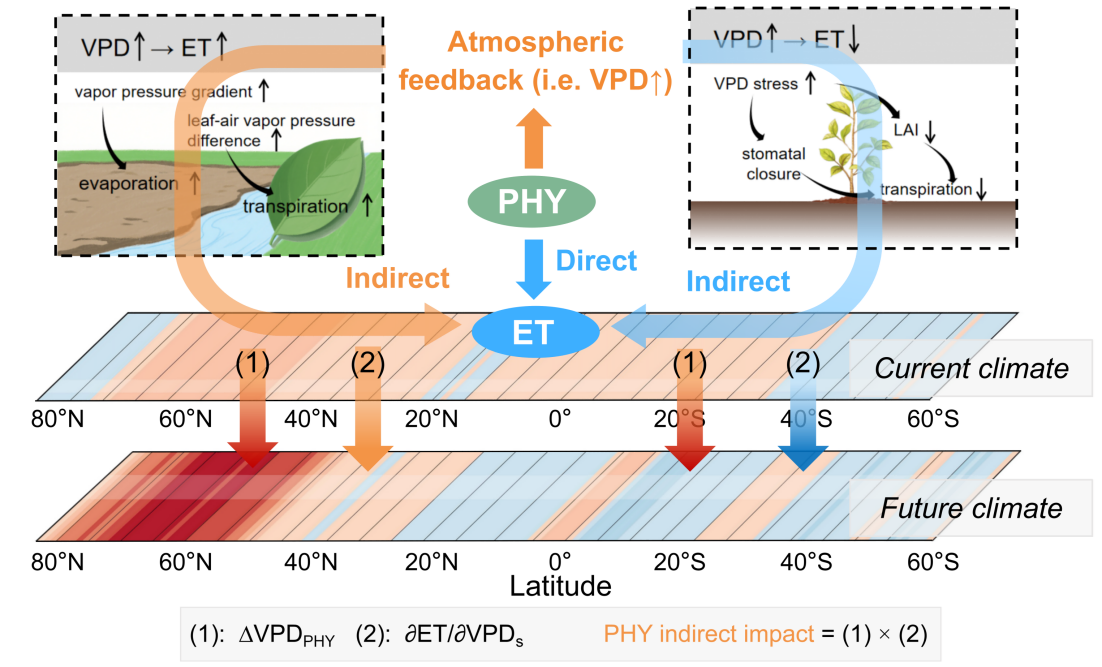
Direct and indirect pathways through which CO2 physiological effects influence evapotranspiration. (Image by IAP)
<関連情報>
- https://english.cas.cn/newsroom/research-news/202606/t20260625_1174884.shtml
- https://www.pnas.org/doi/10.1073/pnas.2534643123
CO2の蒸発散に対する生理学的影響の過大評価の可能性 A potential overestimation of CO2 physiological effects on evapotranspiration
Yi Hao, Xing Yuan, Xiazhen Xi, +2 , and Peili Wu
Proceedings of the National America of Sciences Published:June 24, 2026
DOI:https://doi.org/10.1073/pnas.2534643123
Abstract
It is generally believed that CO2 physiological forcing can partially mitigate land surface drying under global warming by reducing stomatal conductance and evapotranspiration. Most of this type of study focuses on the direct regulation by vegetation physiology, overlooking interactive feedback from the atmosphere. Using fully coupled earth system model simulations, we find that the physiological benefit may have been optimistically overestimated. Vegetation-induced energy change may in turn further affect atmospheric vapor pressure deficit (VPD), exerting extra evapotranspiration demand indirectly. Indirect VPD feedback over northern mid-high latitudes could offset 54% (±26%) of evapotranspiration reduction driven by stomatal closure under current CO2 condition, and that proportion increases to 68% (±18%) at 4 × CO2. The enhanced VPD feedback is largely driven by vegetation-mediated albedo decline and temperature rise in northern mid-high latitudes, which intensifies evapotranspiration loss as stomatal constraints are minimal. These are important findings, substantially limiting the physiological benefits of CO2 with extra pressure on surface aridification and water resources.