2026-06-25 名古屋大学
<関連情報>
- https://www.nagoya-u.ac.jp/researchinfo/result/2026/06/post-1021.html
- https://iopscience.iop.org/article/10.1088/1361-6560/ae79cb
高解像度トラックイメージングを用いた実験的に検証されたGATEシミュレーションによるマイクロドシメトリーのためのGAGGと生体組織におけるアルファ粒子トラック特性の比較 Comparison of alpha-particle track characteristics in GAGG and biological tissues for microdosimetry using experimentally validated GATE simulations with high-resolution track imaging
Kohei Nakanishi, Seiichi Yamamoto, Masao Yoshino, Yuto Kamitaka, Noriaki Miyaji, Kenta Miwa and Ryuichi Nishii
Physics Medicine & Biology Published: 24 June 2026
DOI:10.1088/1361-6560/ae79cb
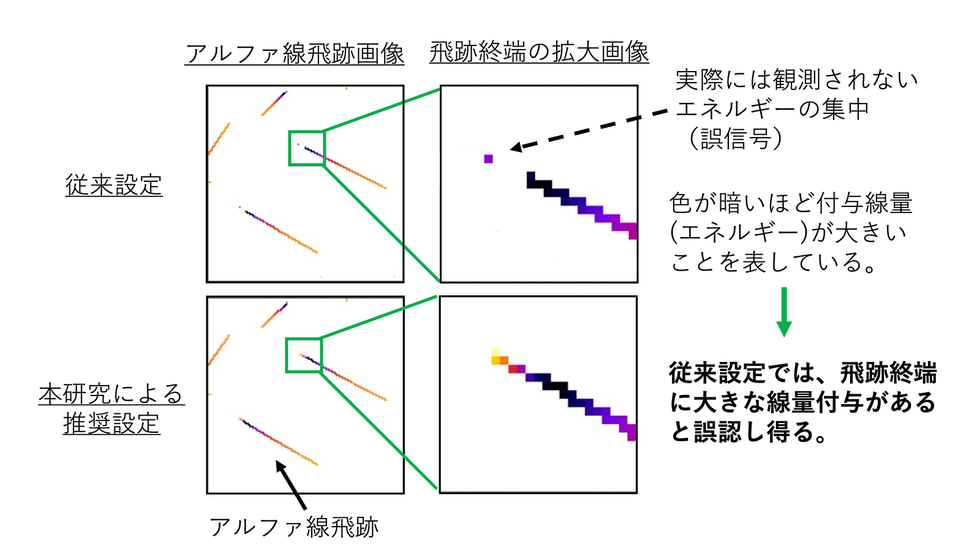
Abstract
Objective. Real-time imaging of alpha-particle tracks in scintillators is promising for microdosimetric studies of alpha-emitting radionuclides in targeted radionuclide therapy. However, when inorganic scintillators such as Gd3Al2Ga3O12 (GAGG) are used, the observed track characteristics differ from those in biological tissues. This study aimed to validate the GATE (geant4 application for tomographic emission) simulation framework using experimentally obtained alpha-particle track images and to compare track characteristics in GAGG and biological tissue-equivalent media. Such analysis is essential for quantitatively interpreting track images obtained with scintillator-based imaging systems in microdosimetry. Approach. Alpha-particle track images were obtained using a real-time high-resolution imaging system based on a GAGG scintillator and an Am-241 source. Simulated track ranges were compared with experimental images. The finalRange parameter in GATE was optimized because it affects the Bragg peak shape of alpha particles. Furthermore, simulated track characteristics in biological tissue-equivalent media were quantitatively compared with those in GAGG. Main Results. A bright endpoint artifact was identified in simulated alpha-particle tracks, originating from the particle transport mechanism implemented in Geant4/GATE and depending on the finalRange value. The simulated and experimental ranges of alpha particles in GAGG were 8.20 μm and 8.05 μm, respectively, demonstrating good agreement. Linear energy transfer (LET) values in GAGG were 2.8 and 1.8 times higher than those in adipose and bone, respectively. Significance. Recognizing this artifact is important for correct interpretation of LET distributions in microdosimetric evaluations. Our results demonstrated that GATE can accurately reproduce alpha-particle track characteristics and provides a useful framework for interpreting track structures observed in inorganic scintillators in terms of energy deposition in biological tissues. Nevertheless, optimization of the finalRange parameter is required for reliable microdosimetric evaluation.