2026-06-26 東京科学大学
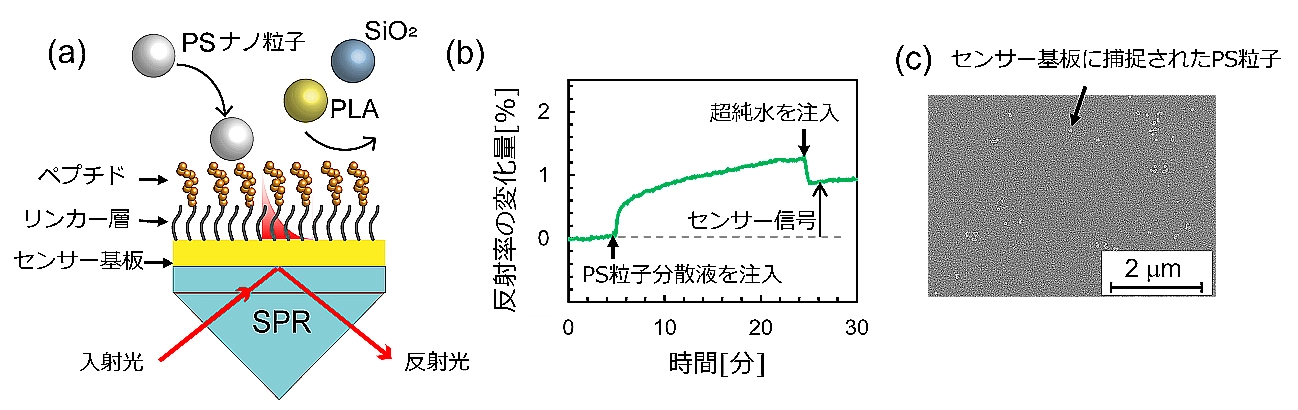
図1. (a)ナノプラスチック検出SPRセンサーの概要図。
<関連情報>
- https://www.isct.ac.jp/ja/news/atok186pu332
- https://www.sciencedirect.com/science/article/pii/S0956566326003805?via
環境水中のナノプラスチック検出のためのプラスチック結合ペプチドを用いた表面プラズモン共鳴バイオセンサー Surface plasmon resonance biosensor with plastic-binding peptide for nanoplastic detection in environmental water
Mikihisa Hirose, Prairsunan Chanpanich, Kimleng Keang, Shuo Cheng, Mana Toma
Biosensors and Bioelectronics Available online: 9 May 2026
DOI:https://doi.org/10.1016/j.bios.2026.118748
Abstract
Nanoplastics are emerging environmental contaminants that pose potential risks to ecosystems and human health, yet their reliable detection remains challenging due to their small size. Here, we present a surface plasmon resonance (SPR) biosensor that employs a polystyrene-binding peptide (PS-BP) as a recognition element for polystyrene nanoparticles (PS-NPs). This peptide–nanoplastic interface enabled selective binding, confirmed through controlled experiments and scanning electron microscopy (SEM). Quantitative analysis of SPR response revealed a detection limit of 1.3 μg/mL within 20 min in ion-adjusted laboratory water without labeling. Furthermore, the applicability of the biosensor was demonstrated by spiking PS-NPs into filtered aquarium and pond waters. These results highlight peptide-functionalized SPR substrates as a promising strategy for nanoplastic detection, with potential extension to broader environmental and biological sensing applications.