2026-06-12 バーミンガム大学
<関連情報>
- https://www.birmingham.ac.uk/news/2026/scientist-creates-miniuniverse-to-measure-time-without-a-clock
- https://journals.aps.org/prresearch/abstract/10.1103/1h9j-df4k
冷却原子を用いて時間の問題検証を行う Testing the problem of time with cold atoms
Giovanni Barontini
Physical Review Letters Published 11 June, 2026
DOI: https://doi.org/10.1103/1h9j-df4k
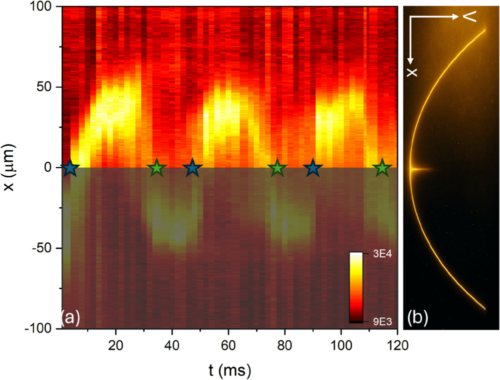
Abstract
We realize a cold-atom system to quantitatively test relational constructions of time. A well-isolated atomic Bose-Einstein condensate evolves in a conservative trap that is partitioned by a thin optical barrier into an observed and unobserved sector, with negligible dissipation on the experimental timescale. Motivated by relational-time approaches discussed in the Wheeler-DeWitt framework, we ask whether the dynamics of the observed sector can be ordered using only internal degrees of freedom. To this end, we construct an entropic time from an experimentally defined coarse-grained entropy and demonstrate that it can robustly order the events in the observed sector across repeated cycles of expansion and recollapse. We finally derive an effective Schrödinger equation parametrized by this internal time and show that it is able to reproduce the measured evolution. These results establish a controlled experimental setting in which relational-time constructions can be quantitatively tested.