
2026-06-03 中国科学院(CAS)
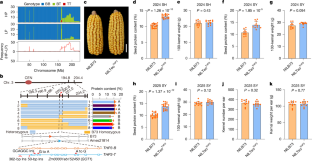
中国では飼料用タンパク源として大豆粕への依存度が高く、2025年の大豆輸入量は1億トンを超えたが、トウモロコシのタンパク質含有率は一般に約8%と低い。研究チームは野生トウモロコシ由来のTHP9-Tを2022年に発見した後、新たにTHP3-Tを特定した。複数年・複数地点での試験の結果、THP3-Tは収量を維持したまま粒中タンパク質含有率を10%から13%超へ向上させ、施肥量が少ない条件でも高タンパク性を維持できることが確認された。さらに両遺伝子を組み合わせることで相乗効果が生じ、タンパク質含有率は15%まで上昇した。
研究チームはマーカー支援育種を用いて中国主要品種の親系統80系統以上を改良し、広く栽培される「鄭単958」のタンパク質含有率も8.5%から12%超へ高めた。飼料用トウモロコシ全体のタンパク質含有率が4ポイント向上すれば、3,000万トン超の輸入大豆に相当するタンパク質を代替できる可能性があり、飼料コスト削減や農家所得向上への貢献が期待される。
<関連情報>
- https://english.cas.cn/newsroom/cas-in-media/202606/t20260604_1161110.shtml
- https://www.nature.com/articles/s41586-026-10575-8
テオシントの対立遺伝子はトウモロコシの窒素同化と種子タンパク質を向上させる Teosinte alleles enhance nitrogen assimilation and seed protein in maize
Yongcai Huang,Yidong Zhu,Yahui Cui,Guolong Shi,Xiaoxian Wu,Wenhao Li,Zhiteng Chen,Yu Zhou,Yincong Gu,Zhigui Bao,Shiqi Luo,Xingguo Wu,Ruifan Li,Jingjing Liu,Xiangjie Dai,Junxin Liu,Di Chen,Lulu Gao,Chong You,Youliang Li,Yu Zhang,Wenqin Wang,Haihai Wang & Yongrui Wu
Nature Published:03 June 2026
DOI:https://doi.org/10.1038/s41586-026-10575-8
Abstract
During maize (Zea mays L.) domestication, seed protein content sharply declined1,2. In plants, glutamine and asparagine levels are closely correlated with protein content3,4. Asparagine is synthesized from glutamine, a process catalysed by asparagine synthase5. Teosinte harbours a superior haplotype of asparagine synthase 4 (ASN4)2. Here, we report that teosinte also possesses a superior haplotype gene promoting glutamine synthesis. We identify and clone teosinte high protein 3 (THP3), which encodes glutamate-oxaloacetate transaminase 1 (GOT1), a key enzyme involved in nitrogen assimilation and carbon–nitrogen balance. The superior THP3-T allele, subjected to negative selection during domestication, has natural variations that boost both its expression and enzymatic activity. Overexpressing THP3-T, but not the modern THP3-B allele, significantly increases seed protein, representing altered carbon–nitrogen composition. Pyramiding THP3-T with THP9-T (the latter encoding asparagine synthase 4 (ASN4)) synergistically elevates both seed and whole-plant protein in elite hybrids while maintaining yield. Our findings demonstrate a powerful strategy for crop improvement by reintroducing beneficial rare alleles disfavoured during domestication from wild relatives.
/https%3A%2F%2Ffilelist.tudelft.nl%2FLR%2FActueel%2FNews%2F2026%2FQ2%2Fcollage1.png%3Fhash%3Df4bef09816 "ムササビの飛行制御を模倣したドローンを開発(Flying Squirrel Drone Reshapes Drone Design)")