2025-08-08 東京理科大学,住友電気工業株式会社,東京大学
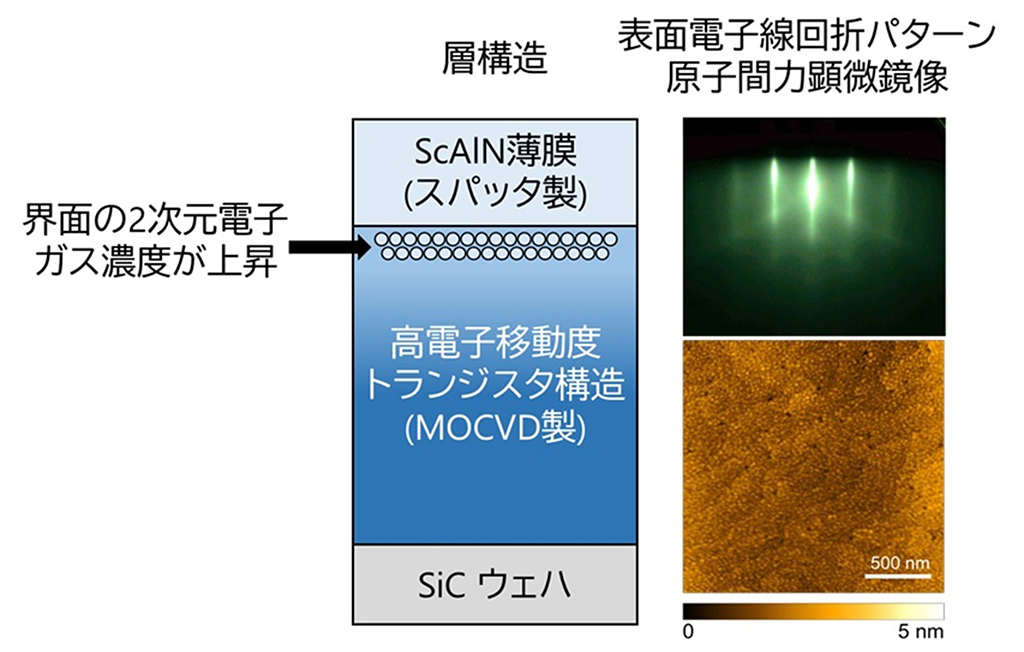 図 スパッタ法で基板上に製膜したScAlN薄膜(左)、RHEEDパターン(右上)、およびAFM像(右下)
<関連情報>
- https://www.tus.ac.jp/today/archive/20250722_6391.html
- https://pubs.aip.org/aip/apm/article/13/8/081112/3358093/Effect-of-growth-temperature-on-the-structural-and
成長温度がAlGaN/AlN/GaNヘテロ構造上のスパッタエピタキシャルScAlNの構造的および電気的特性に与える影響
Effect of growth temperature on the structural and electrical properties of sputter-epitaxial ScAlN on AlGaN/AlN/GaN heterostructures
Shunsuke Ota;Tomoya Okuda;Kouei Kubota;Yusuke Wakamoto;Takuya Maeda;Takahiko Kawahara;Kozo Makiyama;Ken Nakata;Atsushi Kobayashi
APL Materials Published:August 07 2025
DOI:https://doi.org/10.1063/5.0281540
ScAlN is an attractive barrier material for GaN-based high electron mobility transistors (HEMTs) due to its large polarization and ferroelectricity. However, the influence of growth temperature on its structural and electrical properties remains insufficiently understood. To address this, we investigated the effects of growth temperature on the structural and electrical properties of Sc0.10Al0.90N films epitaxially grown on AlGaN/AlN/GaN heterostructures through sputtering. Atomic force microscopy and reflection high-energy electron diffraction revealed that surface morphology and crystallinity improved significantly with increasing growth temperature, with step-flow growth achieved at 750 °C. X-ray diffraction measurements confirmed coherent growth of all ScAlN layers and a decrease in the c-axis lattice constant with increasing growth temperature. Hall effect measurements demonstrated that the sheet carrier density of ScAlN/AlGaN/AlN/GaN grown at 750 °C reached 1.1 × 1013 cm−2, nearly three times higher than that of the structure without ScAlN. The sheet carrier density was lower than that calculated by one-dimensional Poisson–Schrödinger simulations using the theoretical polarization, suggesting the possible existence of negative fixed charges at the ScAlN/AlGaN regrown interface and within the ScAlN layer. These results highlight the critical role of growth temperature in sputter epitaxy of ScAlN and demonstrate the feasibility of using high-quality ScAlN as a barrier layer for GaN-based HEMTs through an industrially compatible process.