
2026-10-22 北海道大学
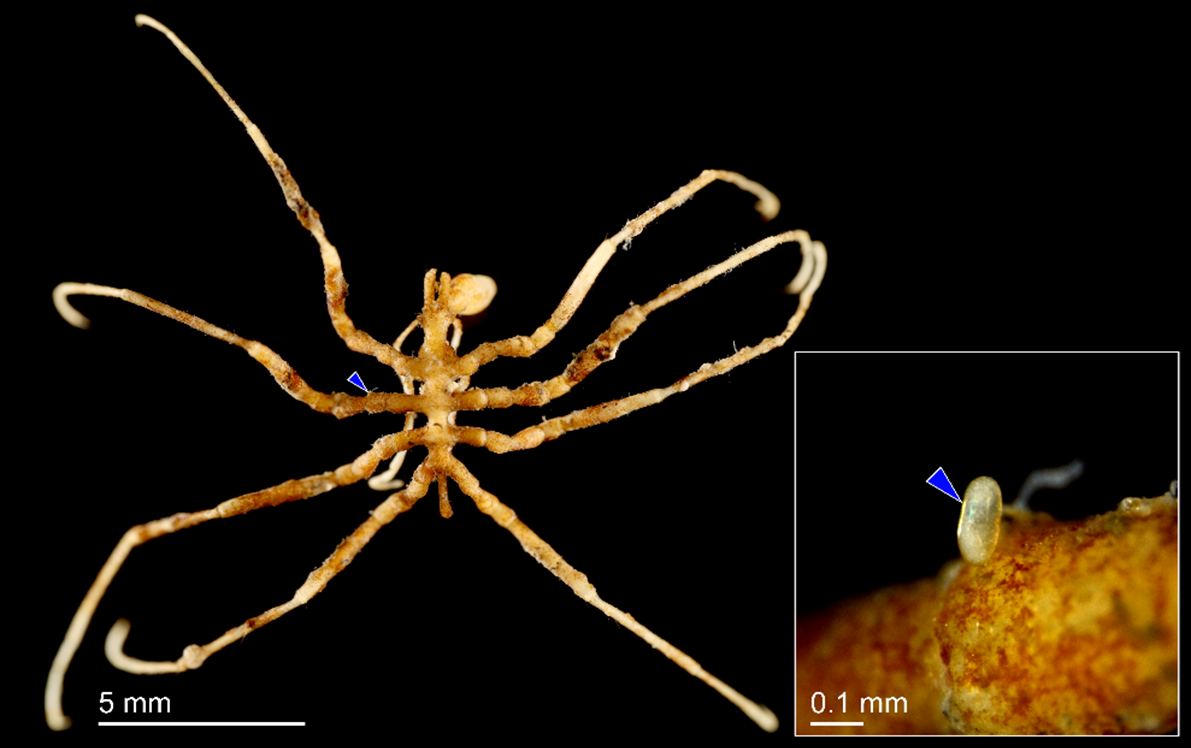
ヘビジタトックリウミグモ(左)にくっつく扁形動物の卵嚢(右)
<関連情報>
- https://www.hokudai.ac.jp/news/2026/10/post-2479.html
- https://pfeil-verlag.de/wp-content/uploads/2026/10/spx49-1_02_se.pdf
深海のゆりかご:深海性ウミグモから得られた扁形動物の卵嚢、及びAscorhynchus mariae Turpaeva, 1971の統合的再記載
Abyssal cradle: flatworm egg capsules on a deep-sea sea spider, with an integrative redescription of Ascorhynchus mariae Turpaeva, 1971
Shogo Sekiguchi & Keiichi Kakui
SPIXIANA Published:2026-10-16
We redescribe the deep-sea sea spider Ascorhynchus mariae Turpaeva, 1971 based on one male and one female collected at the depths of 3685-3893 m in the Japan Trench. This is the third and deepest record of this species globally and the first in Japanese waters, and expands its known distributional range from only the Kuril-Kamchatka Trench to the Japan Trench. We determined sequences for its 18S rRNA (18S) and cytochrome c oxidase subunit I (COI) genes. On the female specimen, we found flatworm egg capsules, which represents the first reported case of flatworms utilizing pycnogonids as a substrate for egg attachment. A molecular phylogenetic analysis based on 18S and 28S rRNA (28S) sequences placed the flatworm species firmly within the family Trigonostomidae (Rhabdocoela) of free-living flatworms, and as the sister taxon to a Ptychopera clade, with moderate branch support. This provides the second-deepest record for free-living flatworms.

