2026-05-12 中国科学院(CAS)
<関連情報>
- http://english.ib.cas.cn/ne/news/202605/t20260512_1159143.html
- https://www.sciencedirect.com/science/article/abs/pii/S0031018226003093
中国南西部横断山脈における過去14,200年間の気候変動に対する植生と植物多様性の応答 Response of vegetation and plant diversity to climate change over the past 14.2 ka in the Hengduan Mountains, southwestern China
Hui Zeng, Feng Qin, David K. Ferguson, Yu-Fei Wang, Yi-Feng Yao
Palaeogeography, Palaeoclimatology, Palaeoecology Available online: 27 April 2026
DOI:https://doi.org/10.1016/j.palaeo.2026.113846
Highlights
- A multi-proxy analysis of pollen, grain size, and loss-on-ignition was conducted.
- Solar insolation and Indian summer monsoon drove climate and vegetation changes.
- Plant diversity exhibited a complex response to three natural warming events.
- Warming impacted plant diversity by altering vegetation structure and composition.
Abstract
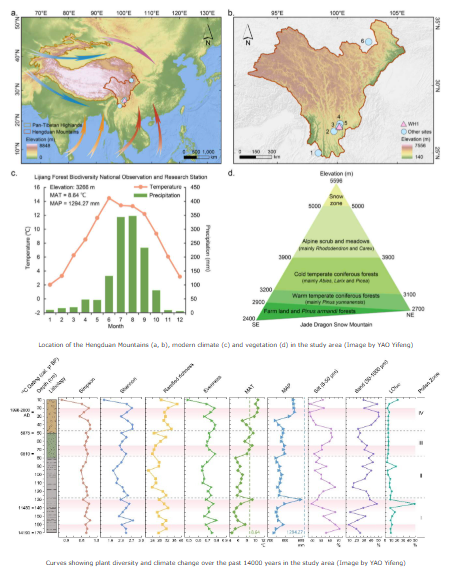
Understanding how climate warming affects plant diversity in montane ecosystems is one of the central issues in studies of past global change. However, this issue remains inadequately understood, especially within biodiversity hotspots. Here, we present a multi-proxy analysis– including pollen, grain size, and loss-on-ignition–conducted on a 170 cm-deep soil section from the Hengduan Mountains of southwestern China to elucidate how vegetation and plant diversity have responded to climate change over the past 14.2 ka. Our results show that 1) Solar insolation and the Indian summer monsoon influenced climate variability in the region, triggering an alternation between mixed coniferous and broad-leaved forest (mainly Pinus, Abies, and evergreen sclerophyllous Quercus) and lakeside herbaceous vegetation. 2) Plant diversity exhibited a complex response to three natural warming events – the Bølling-Allerød warm period (14.2–12.8 cal. ka BP), the end of the Younger Dryas event (12.8–11.5 cal. ka BP), and the Holocene Climatic Optimum (6.7–5.3 cal. ka BP). Specifically, species richness increased, while the Simpson index, Shannon-Wiener index, and evenness decreased. 3) Climate warming influenced plant diversity by modifying vegetation structure and composition, leading to a more uneven distribution of species in the communities. These findings not only offer a scientific basis for biodiversity conservation and sustainable development in the montane regions of southwestern China under future warming scenarios, but also serve as a valuable reference for examining deep-time plant diversity responses to climate warming in similar montane ecosystems worldwide.