
2026-10-14 オックスフォード大学
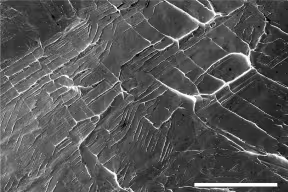
Electron microscopy image showing new defects forming between neighbouring crystals of the niobium-titanium-based alloys. Image credit: Cook et al. 2026
<関連情報>
- https://www.ox.ac.uk/news/2026-10-14-new-study-reveals-metal-alloys-that-unexpectedly-resist-extreme-cold-staying-tough
- https://www.nature.com/articles/s41586-026-11065-7
競合するメカニズムが、20 K において bcc 二元合金および中エントロピー合金を強化する Competing mechanisms toughen bcc binary and medium-entropy alloys at 20 K
David H. Cook, Xiaoyu Chen, Michael O’Leary, Satish Rao, Wenqing Wang, Calvin H. Belcher, Madelyn Payne, Pedro Borges, Tung Lik Lee, Arun Devaraj, Mark Asta, Enrique J. Lavernia, Diran Apelian, Andrew M. Minor, Dong Liu, Punit Kumar & Robert O. Ritchie
Nature Published:14 October 2026
DOI:https://doi.org/10.1038/s41586-026-11065-7
Abstract
Plastic deformation in body-centred cubic (bcc) metals and alloys is conventionally mediated by screw dislocations. Their temperature-sensitive motion is attributed to a steep rise in strength with decreasing temperature that constricts plastic zones at crack tips, leading to a ductile-to-brittle transition1. Here we evaluated the mechanical properties of group IV–V bcc refractory alloys with similar electronic structures at 20 K and found that these materials instead exhibit a plateau in tensile yield strength and fracture toughness as a function of temperature, with no apparent ductile-to-brittle transition. This behaviour arises from the global activation of twinning and an ω-phase transformation, which nucleate dislocations at interfaces before global dislocation motion. The initial mechanism is temperature insensitive and controls yielding, thereby preventing a crack-tip plastic zone from constricting with decreasing temperature.

