2026-08-25 京都大学
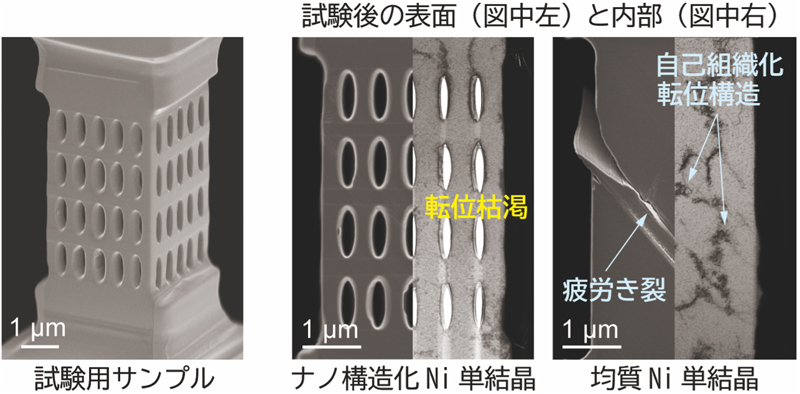
数百ナノメートルサイズの孔を周期的に配列させた金属単結晶(ニッケル(Ni))。繰り返し負荷によって転位は周囲の表面から放出され、材料内部では転位の枯渇を生じ、高疲労耐性化が実現できる。(作成者:杉坂浩太(澄川研究室)、澄川貴志、撮影者:杉坂浩太)
<関連情報>
- https://www.kyoto-u.ac.jp/ja/research-news/2026-08-25-1
- https://advanced.onlinelibrary.wiley.com/doi/10.1002/adma.74447
転位の枯渇によって疲労耐性を向上させるナノ構造化⾦属メタマテリアル Nano-Architected Metallic Metamaterial With Enhanced Fatigue Resistance via Dislocation Starvation
Kota Sugisaka, Yamato Ishizaka, Hiroki Ikeda, Shigeo Arai, Masataka Abe, Yoshitaka Umeno, Hiroyuki Shima, Takashi Sumigawa
Advanced Materials Published: 23 August 2026
DOI:https://doi.org/10.1002/adma.74447
ABSTRACT
Metal single crystals often suffer from severe strain localization under cyclic loading due to the absence of grain boundaries that act as crystallographic obstacles, resulting in their low fatigue resistance despite their advantages in applications requiring microstructural stability. This study demonstrates that this intrinsic trade-off can be overcome by exploiting dislocation starvation that arises as metal single crystals are reduced to the nanoscale. Tension–compression fatigue tests on 300 nm-wide nickel (Ni) single crystals reveal a fatigue-crack initiation limit exceeding 800 MPa, more than an order of magnitude higher than that of bulk Ni single crystals. In situ transmission electron microscopy experiments directly capture dislocation starvation during cyclic loading, confirming that strain localization, which typically serves as a precursor to fatigue-crack initiation, is completely suppressed. Based on this mechanism, a nano-architected Ni single-crystal metamaterial is designed to macroscopically harness dislocation starvation. Despite a relative density of only ∼50%, the metamaterial exhibits a fatigue-crack initiation limit about twice that of homogeneous Ni single crystals. These findings introduce a dislocation-starvation-driven design principle for simultaneously enhancing fatigue resistance and reducing weight in metal single crystals, thereby opening a new paradigm beyond the conventional limitations.