
2026-10-13 東北大学
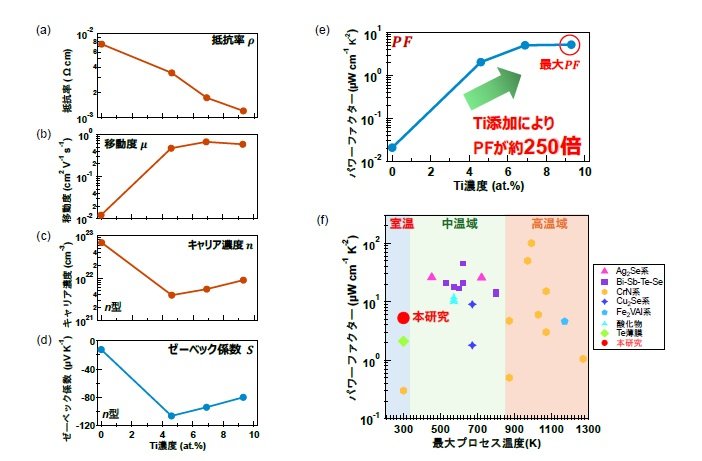
図1. Ti添加CrN薄膜の室温における電気特性と熱電特性のTi濃度依存性。
<関連情報>
- https://www.tohoku.ac.jp/japanese/2026/10/press20261013-03-Ti.html
- https://pubs.rsc.org/ta/article/doi/10.1039/d6ta04854d/1368279/Breaking-the-trade-off-in-CrN-thermoelectrics-via
Tiドーピングによる CrN熱電材料のトレードオフの打破:室温で作製した薄膜からデバイスレベルの性能まで
Breaking the trade-off in CrN thermoelectrics via Ti doping: from room-temperature fabricated films to device-level performance
Junya Kurahashi;Yi Shuang;Yuji Sutou
Journal of Materials Chemistry A Published:12 October 2026
DOI:https://doi.org/10.1039/d6ta04854d
Thermoelectric thin films capable of efficient energy conversion under low-temperature processing conditions are highly desirable for next-generation energy harvesting applications. Here, we report a Ti-doping strategy to modulate carrier transport in CrN thin films and achieve enhanced thermoelectric performance without high-temperature deposition. A maximum power factor of 5.26 µW cm−1 K−2, 250 times higher than undoped CrN, is realized by Ti doping at room temperature. Beyond material-level optimization, device-level evaluations demonstrate that the n-type Ti doped CrN device delivers high power output, while in-plane devices exhibit enhanced voltage generation arising from the combined Seebeck effect. Notably, the achieved power density is comparable to that of state-of-the-art thermoelectric thin films such as chalcogenide-based materials, despite the absence of high-temperature or epitaxy processing. These results establish nitride-based thin films as a competitive platform for thermoelectric energy conversion and provide a viable pathway toward high-performance devices compatible with scalable and flexible fabrication processes.
