2026-04-21 東北大学
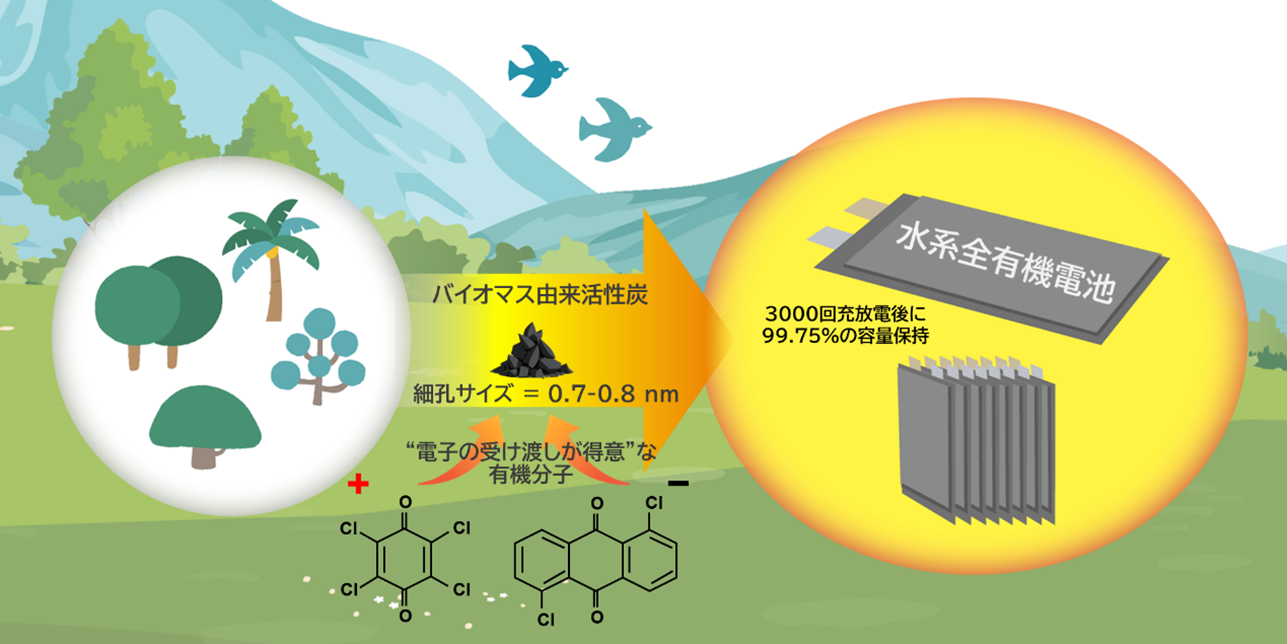
図1. 本取り組みの概要図
<関連情報>
- https://www.tohoku.ac.jp/japanese/2026/04/press20260421-02-biomass.html
- https://www.tohoku.ac.jp/japanese/newimg/pressimg/tohokuuniv-press20260421_02web2_biomass.pdf
- https://pubs.rsc.org/en/content/articlelanding/2026/ta/d5ta10161a
バイオマス由来炭素の微細孔工学による、耐久性と高負荷に対応した全有機水系パウチ電池の開発 Micropore engineering of biomass-derived carbon for durable, high-loading aqueous all-organic pouch batteries
Keisho Ri,Nagihiro Haba,Ryotaro Kumashiro,Ayaka Kido,Tomoya Yamada,Yuto Katsuyama,Masaru Watanabe,Kayoko Kobayashi and Yuta Nakayasu
Journal of Materials Chemistry A Published:24 Mar 2026
DOI:https://doi.org/10.1039/D5TA10161A
Abstract
Aqueous all-organic batteries based on low-molecular-weight quinones are promising candidates for sustainable energy storage. However, their performance is limited by incomplete utilization of the monomers within porous carbon hosts and further deteriorates upon scaling to practical device formats. Here, we demonstrate that molecule-specific pore-structure design in biomass-derived activated carbons (ACs) enables a high-loading aqueous all-organic pouch cell with thick-film electrodes (areal active-material loading ≈28 mg cm−2, areal energy density of ≈1 mWh cm−2), delivering an energy density of 17.3 Wh kg−1 at 0.1C and retaining 99.75% of its capacity after 3000 cycles. These performance and durability metrics compare favorably with previously reported aqueous all-organic batteries at high areal loading and are consistent with the sealed, low-electrolyte pouch configuration and micropore confinement, which together suppress dissolution-based degradation. To rationalize these device-level gains, we developed design principles for biomass-derived AC hosts and evaluated their applicability in the fabrication of high-loading aqueous all-organic pouch cells. Pore analysis revealed distinct governing factors for the two quinones. While both primarily occupy 0.7–0.8 nm micropores, tetrachloro-1,4-benzoquinone (TCBQ) utilization is facilitated by the presence of a mesopore network; accordingly, in carbons lacking mesopores, diffusion limitations lead to significantly suppressed TCBQ utilization. In contrast, 1,5-dichloroanthraquinone utilization is determined by the 0.7–0.8 nm micropore volume and suffers from a molecular sieving effect in low-surface-area carbons, where constricted pore entrances exclude the molecule. This work demonstrates that rational, molecule-specific design of biomass-derived ACs can translate nanoscale confinement principles into practical device-level gains, paving the way for durable and sustainable energy storage.