2026-09-25 京都大学
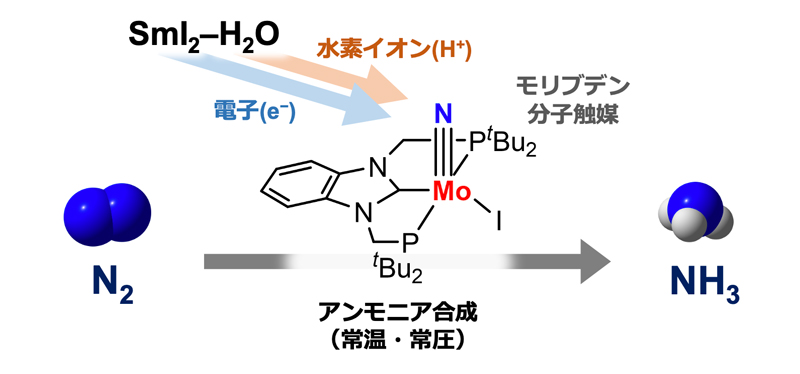
アンモニア合成反応におけるモリブデン分子触媒の作用メカニズムの解明
作成:中村泰司
<関連情報>
- https://www.kyoto-u.ac.jp/ja/research-news/2026-09-25
- https://www.nature.com/articles/s41467-026-77505-0
SmI2‒H2O 系により駆動されるMo触媒を⽤いた窒素固定反応機構の解明 Unveiling full mechanistic picture of Mo-catalysed nitrogen fixation driven by SmI2–H2O system
Taiji Nakamura, Kazuya Arashiba, Asuka Konomi, Hiromasa Tanaka, Yoshiaki Nishibayashi & Kazunari Yoshizawa
Nature Communications Published:24 September 2026
DOI:https://doi.org/10.1038/s41467-026-77505-0
Abstract
Ammonia is an essential chemical that underpins modern agriculture and industry, but the direct conversion of dinitrogen to ammonia under mild conditions remains highly challenging. To this end, molybdenum nitride complexes bearing 1,3-bis(di-tert-butylphosphinomethyl)benzimidazole-2-ylidene pincer ligands have been shown to catalyse ammonia formation from dinitrogen using samarium diiodide and water. However, the catalytic mechanism remains poorly understood owing to limited information on the key intermediates and the solution-state speciation of the samarium reductant. Here we show a full catalytic mechanism by combining mechanistic experiments and theoretical analyses. We isolate molybdenum methylimide and molybdenum methylamide complexes as stable analogues of catalytic intermediates, providing direct experimental evidence for the proposed catalytic pathway. Theoretical studies further suggest a plausible structure of the tetrahydrofuran-solvated samarium diiodide–water complex, and subsequent mechanistic analyses reveal that ammonia formation proceeds through proton-coupled electron transfer. Building on these experimental and theoretical findings, we identify the molybdenum–imide formation reaction as the most energy-demanding step. These findings provide a framework for understanding catalytic ammonia formation and inform future efforts to improve dinitrogen reduction catalysts.