2026-08-27 東京科学大学
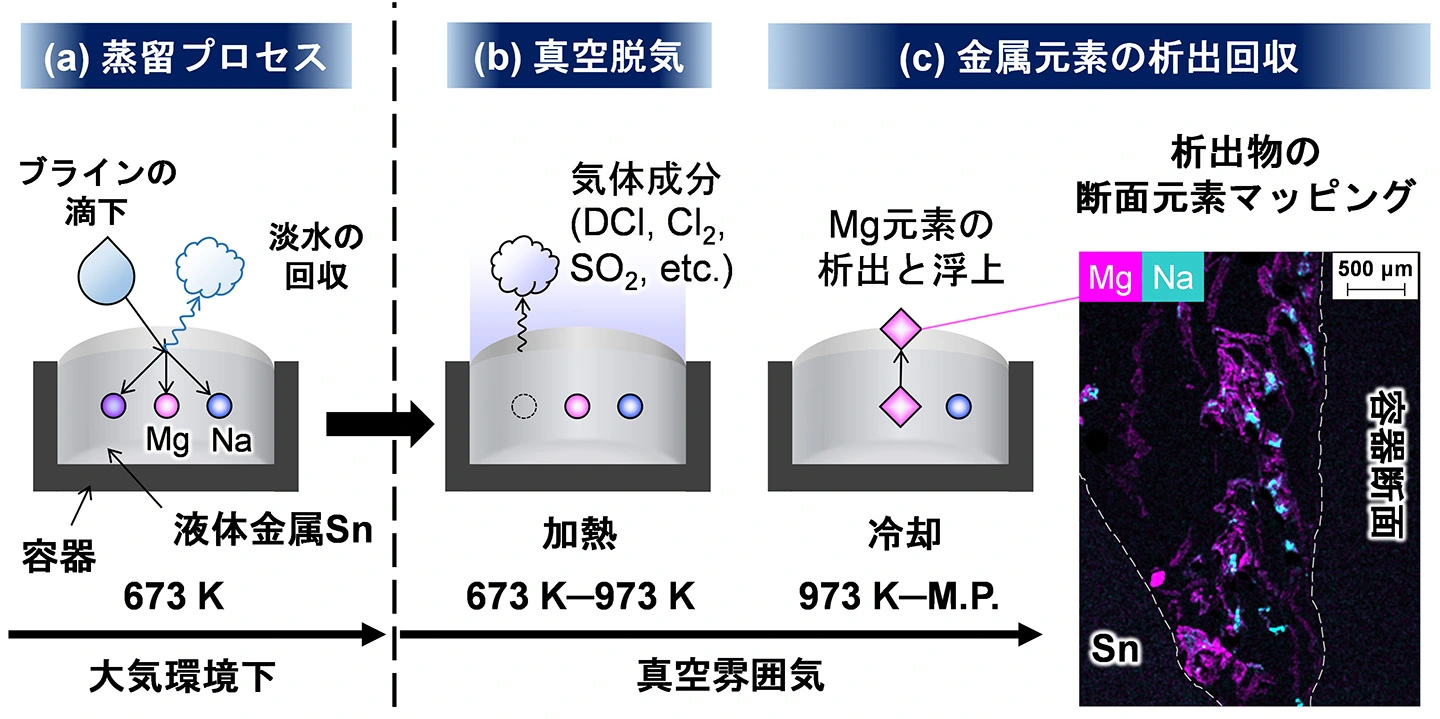
図1. (a)液体金属Sn直接接触式蒸留プロセス、(b)真空脱気による気体成分の除去、(c)冷却時コールドトラップ効果によるMg含有析出物の析出回収
<関連情報>
- https://www.isct.ac.jp/ja/news/9g8cf4gognyx
- https://www.sciencedirect.com/science/article/pii/S0011916426007381
真空脱気を併用した液体スズ直接接触脱塩法による海水塩水からのマグネシウム回収 Recovery of magnesium from seawater brine using liquid tin direct-contact desalination assisted by vacuum degassing
Toranosuke Horikawa, Masatoshi Kondo
Desalination Available online: 31 July 2026
DOI:https://doi.org/10.1016/j.desal.2026.120582
Highlights
- Liquid Sn technology was newly employed to recover brine-derived Mg resources.
- Cl and S were removed from liquid Sn by vacuum degassing up to 973 K.
- Thermal desorption spectroscopy revealed distinct gas-release behaviors.
- MgO precipitated without forming low-value chlorides or sulfates.
Abstract
Recovering freshwater and metal resources from seawater desalination brine can contribute to the realization of a sustainable society. The use of liquid metal tin (Sn) has been proposed as a novel method for recovering freshwater, brine-derived metal resources (e.g., Na, Mg, K and Ca) and brine-derived gaseous species (e.g., HCl, Cl2, H2S, SO2 and H2). The purity of the distilled water was sufficiently high to meet the WHO drinking water standard in our previous study. The metal resources were recovered as precipitates during a cold-trap procedure, although the metals reacted with non-metallic elements such as Cl and S. The present study clarified the thermal desorption behavior of brine-derived gaseous species from a liquid Sn pool in the temperature range from 573 K to 973 K following the direct-contact distillation of seawater brine. Brine-derived elements were dissolved and captured in liquid Sn during the distillation experiment using heavy water (D2O) brine. The results of thermal desorption spectroscopy indicated that gases (e.g., DCl, HCl, Cl2, D2, HD, SO2 and H2S) exhibited distinct desorption behaviors under a high vacuum of approximately 10−3 Pa. More than half of the dissolved gaseous species were released, while some remained in liquid Sn. The precipitation of Na was limited after the gas release due to its high solubility in liquid Sn in the metallic state. Mg precipitated separately from Na without forming MgSO4, which is often formed during scale formation. The crystalline phases of the Mg-rich precipitates were identified mainly as MgO by FE-SEM/EBSD analysis.