2026-09-16 東北大学
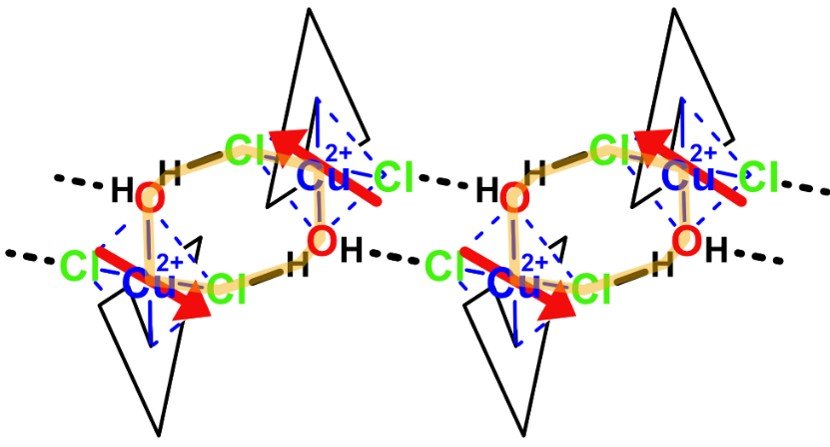
図1.反強磁性的な磁気モーメントの対が形成される様子を表したイメージ図。
<関連情報>
- https://www.tohoku.ac.jp/japanese/2026/09/press20260916-01-water.html
- https://pubs.acs.org/inocaj/article/doi/10.1021/acs.inorgchem.6c01062/5428710/Formation-of-Antiferromagnetic-Spin-Dimer-Induced
フッ素化ピンサー型Cu(II)錯体における水分子の配向秩序化によって誘発される反強磁性スピン二量体の形成 Formation of Antiferromagnetic Spin Dimer Induced by Orientation Ordering of Water Molecule in Fluorinated Pincered Cu(II) Complexes
Kazuhiro Nawa;Dongge Zheng;Katsuki Kinjo;Chun-Wai Tsang;Pin-Xiang Zeng;Gurumallappa Gurumallappa;Norman Lu;Taku J. Sato
Inorganic Chemistry Published: September 11, 2026
DOI:https://doi.org/10.1021/acs.inorgchem.6c01062
Abstract
Pincered transition metal complexes show rich crystal structures owing to intra- and intermolecular hydrogen bonding. Their structural diversity also motivates us to investigate their magnetic interactions mediated by hydrogen bonding. In this study, we report the structural and magnetic properties of copper mononuclear complexes 2FH-CuCl2·H2O and 3F-CuCl2·H2O, with a fluorinated pincered ligand. Both compounds are composed of a uniform chain of molecules coupled by O–H···Cl classical and improper hydrogen-bonding interactions. These compounds exhibit a structural transition induced by orientation ordering of water molecules, which drives bond alternation. The bond alternation also induces dimerization in magnetic interactions between nearest-neighbor Cu ions, evidenced by the magnetization following the isolated antiferromagnetic spin dimer model.