2026-07-02 ミュンヘン大学(LMU)
<関連情報>
- https://www.lmu.de/en/newsroom/news-overview/news/nanotechnology-high-throughput-screening-for-nanocrystals-fa0f7ba3.html
- https://www.nature.com/articles/s41563-026-02607-5
個々のペロブスカイトナノ結晶の高スループットなその場サイズ測定および量子収率決定 High-throughput in situ sizing and quantum yield determination of individual perovskite nanocrystals
Christoph G. Gruber,Andrea Mancini,Nina A. Henke,Carola Lampe,Olivier Henrotte,Michael F. Lichtenegger,Franz Gröbmeyer,Andreas Singldinger,Yi Li,Stefan A. Maier,Alexander S. Urban & Emiliano Cortés
Nature Materials Published:21 May 2026
DOI:https://doi.org/10.1038/s41563-026-02607-5
Abstract
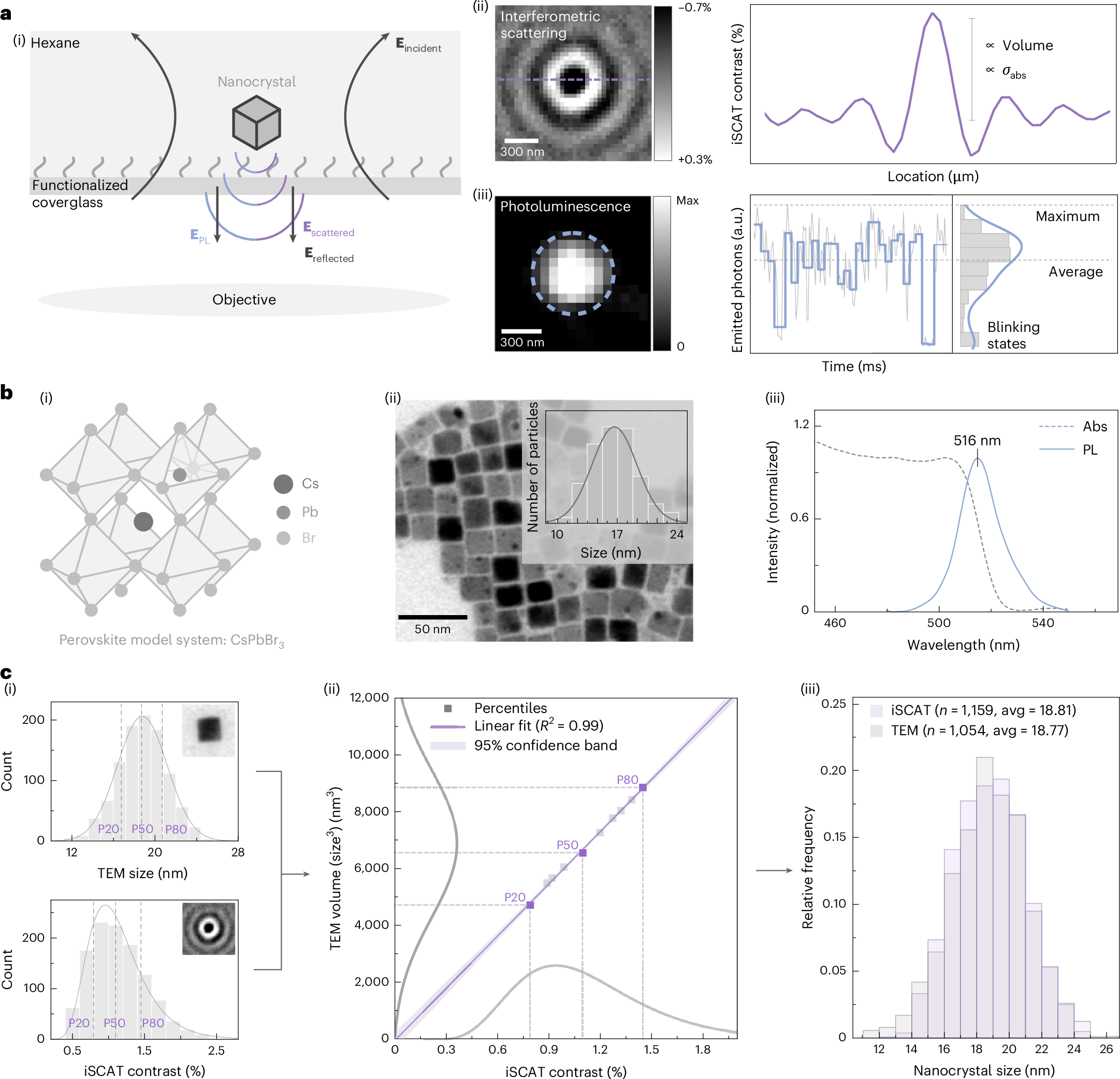
Colloidal nanocrystals exhibit high tunability and low-cost solution processing attractive for next-generation electronic applications. However, colloidal nanocrystals are inherently heterogeneous and the impact of this heterogeneity on device performance has been largely disregarded, since analytical techniques cannot assess the functionality of individual nanocrystals on a large scale. Here we introduce a rapid, in situ method to determine the size and quantum yield of thousands of individual nanocrystals within minutes, based on interferometric scattering microscopy and photoluminescence imaging. Monitoring the life cycle of CsPbBr3 perovskite nanocubes, our approach uncovers phenomena masked by bulk averaging. We find a substantial performance spread across the nanocubes and an anticorrelation of quantum yield and size. During a subsequent solution-phase defect engineering process, we uncover size-dependent enhancement kinetics, which initially favour the enhancement of smaller nanocubes. Finally, we image light-induced degradation by tracking the size reduction and photobleaching of single sub-20-nm nanocrystals, finding material loss decreases at higher laser powers due to the trapping of photoinduced electrons by the formed metallic lead.