2026-09-01 北海道大学
北海道立総合研究機構、森林総合研究所、北海道大学、東京農工大学の研究チームは、2004~2022年度の19年間にわたるアライグマの捕獲数とわなかけ日数を用い、INLA-SPDEモデルによって北海道における生息密度の時空間変化と好適な環境条件を推定した。解析の結果、2004年には道央を中心として高かった生息密度が、2022年には東西南北へ広がり、同じ地域でも年々高まっていることが示された。生息密度は、河川や林縁、草地などの開けた環境、畑の占める割合が大きい地域、冬の平均気温が高い地域で高かった。また、生息密度の高い地域では、その状態が時間経過後も維持される傾向が確認された。計算負荷の小さいINLA-SPDEモデルは、広域を細かなメッシュで解析する実務的手法として有用であり、アライグマの捕獲を優先すべき地域の選定や、生物多様性への影響、人とのあつれきの軽減に役立つことが期待される。
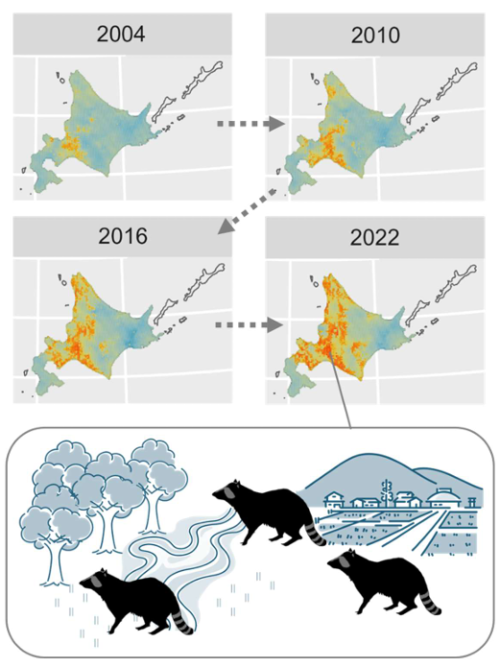
19 年間で、北海道におけるアライグマの生息密度は道央を中心に高まり、分布も広がっています。 生息密度は、河川や林縁、草地などの開けた環境や畑の多い場所などで高いことがわかりました。
<関連情報>
- https://www.hokudai.ac.jp/news/pdf/260901_pr2.pdf
- https://besjournals.onlinelibrary.wiley.com/doi/10.1111/1365-2664.70525
INLASPDEモデルを用いた侵略的外来種の時空間的な相対密度の分布と好適環境の特定 Identifying spatiotemporal patterns of relative abundance and potential source environments in an invasive non-native species using an INLA–SPDE model
Saya Yamaguchi, Hayato Iijima, Mayumi Ueno, Hiroyuki Uno
Journal of Applied Ecology Published: 31 August 2026
DOI:https://doi.org/10.1111/1365-2664.70525
Abstract
- Invasive non-native species are major drivers of biodiversity loss and pose significant economic and public health concerns. To effectively implement strategies that prevent or mitigate their impacts, it is crucial to understand their spatial distribution patterns and source environments.
- In this study, we evaluated the effectiveness of the Stochastic Partial Differential Equation approach with the Integrated Nested Laplace Approximation (INLA–SPDE model) for assessing spatiotemporal distribution patterns of an invasive non-native species. This approach enables efficient estimation of fine-scale spatiotemporal variation over large spatial extents, addressing limitations of static species distribution models while avoiding the high computational cost of fully dynamic models. Using the invasive non-native raccoon Procyon lotor on Hokkaido Island, Japan, as a case study, we (1) estimated relative abundance and (2) identified potential source environments.
- The model captured spatiotemporal variation in raccoon relative abundance and outperformed static models by accounting for spatial dependence. The predictive performance of the model improved with longer training data (up to 15 years) but decreased with increasing forecast horizon, indicating strong potential for informing spatial management while highlighting limitations of long-term forecasting.
- The relative abundance was higher in resource-rich, low-disturbance habitats (e.g. forest edges, crop fields and areas with milder winter conditions), with heterogeneous responses to anthropogenic landscapes indicating context-dependent effects of human-modified habitats. Although capture-based data may include spatial bias in trapping effort, consistent reporting and the model’s spatiotemporal structure suggest that the overall patterns are robust, thereby supporting the identification of priority source areas for management.
- Synthesis and applications: High-resolution spatiotemporal modelling revealed strong temporal persistence in raccoon density, suggesting that high-density areas should be prioritized for future management. Targeted trapping and preventive measures on forest edges, open habitats, riverine habitats and adjacent crop fields may help reduce raccoon populations, biodiversity impacts and human–wildlife conflicts.