2026-09-11 新潟⼤学
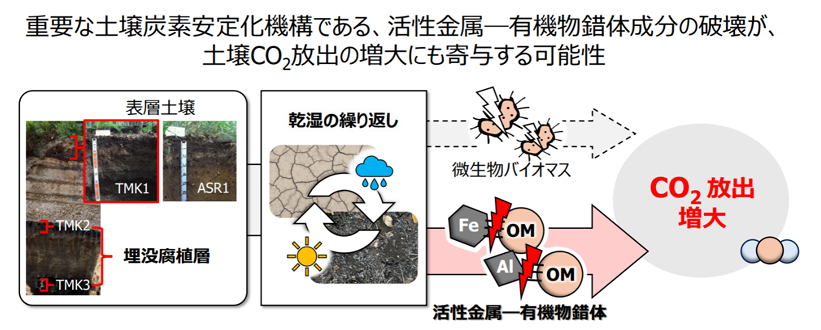
図1. 本研究で提示された乾湿繰り返しによる土壌のCO2放出増大メカニズム
<関連情報>
- https://www.niigata-u.ac.jp/news/2026/1224969/
- https://link.springer.com/article/10.1186/s40645-026-00843-6
埋没腐植層土壌を用いた乾燥・再湿潤サイクル中の土壌からのCO2放出促進に対する有機金属錯体の寄与に関する評価 An evaluation on contribution of organo–metal complexes to enhanced soil CO2 release during drying–rewetting cycles using buried humic horizon soils
Yuri Suzuki,Syuntaro Hiradate,Jun Koarashi,Mariko Atarashi-Andoh,Kazuki Suzuki,Masataka Nakayama,Yukiko Abe,Kouki Hikosaka,Hirofumi Kajino,Hiroyuki Sase,Rieko Urakawa & Hirohiko Nagano
Progress in Earth and Planetary Science Published:04 September 2026
DOI:https://doi.org/10.1186/s40645-026-00843-6
Abstract
Under global warming, precipitation is becoming less frequent but with more intense events, with little change in total precipitation amounts. These shifts have raised concerns about drying–rewetting cycles (DWCs) and their impact on soil organic matter decomposition and carbon dioxide (CO2) release. Microbially derived carbon (C), such as intracellular compounds released by cell lysis and osmolyte turnover, has been considered a primary C source of DWC-induced CO2 release. However, C released from organo–metal complexes disrupted by rapid rewetting has emerged as a significant contributor. To evaluate this contribution, we conducted incubation experiments with a single DWC. Here, we used two buried humic layer soils characterized by abundant organo–metal complexes but low microbial biomass, with two surface soils for comparison. In both buried and surface soils, the DWC consistently led to higher CO2 release rates during incubation compared to the control. The magnitude of the increase in CO2 release from buried humic layers exceeded the measured decreases in microbial biomass C, which represented ≤ 40% of the increase, while the amount of pyrophosphate-extractable organic C associated with organo–metal complexes was at least 90-fold greater than the DWC-induced increase. A re-analysis including data from this study and our previous study showed that the relative CO2 release increase at DWC from control was significantly correlated with the amounts of pyrophosphate-extractable aluminum in the soils. We also observed a shift in bacterial communities in the buried soils toward a nutrient acquisition strategy adapted for rapid growth after rewetting, which may have contributed to the enhanced CO2 release. In the present study, we suggest that organo–metal complexes, traditionally considered a stable C pool, can substantially contribute to DWC-induced CO2 release from buried humic horizons.