2026-06-12 中国科学院(CAS)
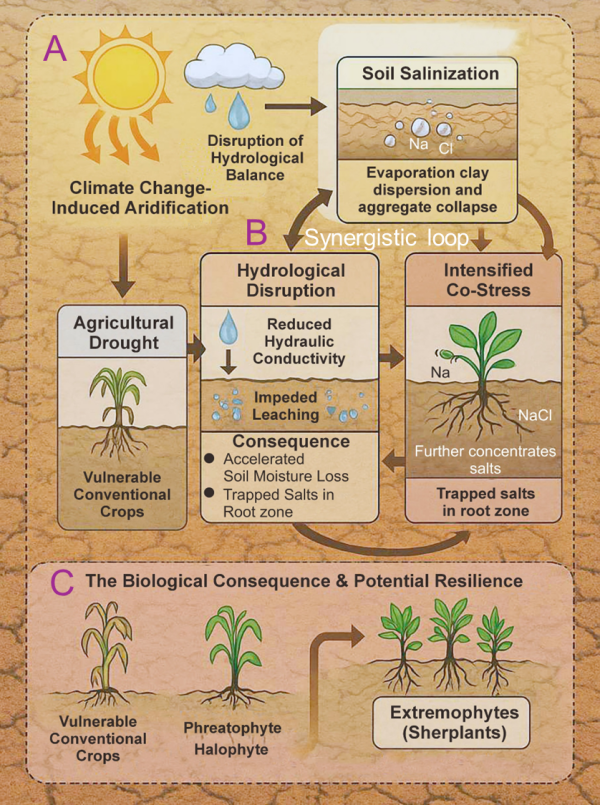
The synergistic salinity-drought feedback loop and the niche for extremophyte resistance. (Image by XIEG)
<関連情報>
- https://english.cas.cn/newsroom/research-news/202606/t20260612_1163504.shtml
- https://onlinelibrary.wiley.com/doi/10.1111/gcb.70949
極限環境植物の適応能力を活用した乾燥地向け作物設計のロードマップ Leveraging Extremophyte Adaptations as a Roadmap for Crop Design for Arid Lands
Mohsin Tanveer, Lei Wang, Hamza Tariq, Muhammad Talha Ramzan, Alisdair R. Fernie, Jaume Flexas, Sergey Shabala, Josep Peñuelas
Global Change Biology Published: 03 June 2026
DOI:https://doi.org/10.1111/gcb.70949
ABSTRACT
Anthropogenic climate change is driving a convergence of rapid soil aridification and secondary salinization that threatens to degrade over half of the world’s arable land. As conventional glycophytic crops reach their physiological limits, global food security depends on decoding the evolutionary adaptations of extremophytes. This review synthesizes the functional traits and ecosystem-level impacts of extremophytes, the native flora of these marginal environments, and evaluates their potential as a biophysical buffer against land degradation. Here, we identify two cornerstone strategies that allow these plants to thrive where others fail: (i) the precise spatiotemporal orchestration of reactive oxygen species (ROS) as critical signaling molecules for developmental plasticity; and (ii) the active recruitment of stress-protective microbiomes via targeted exudation, effectively transforming barren soil into a functional ecosystem. We argue that integrating extremophytes into diversified agroecosystems, through intercropping, phytoremediation rotations, and circular bioeconomy models, offers quantifiable results to enhance ecosystem multifunctionality and sustainably intensify production on degrading lands. By bridging profound mechanistic discovery with ecological engineering, this perspective provides an actionable plan for translating extremophyte biology into crops capable of withstanding a drier future.