2026-09-01 中国科学院(CAS)
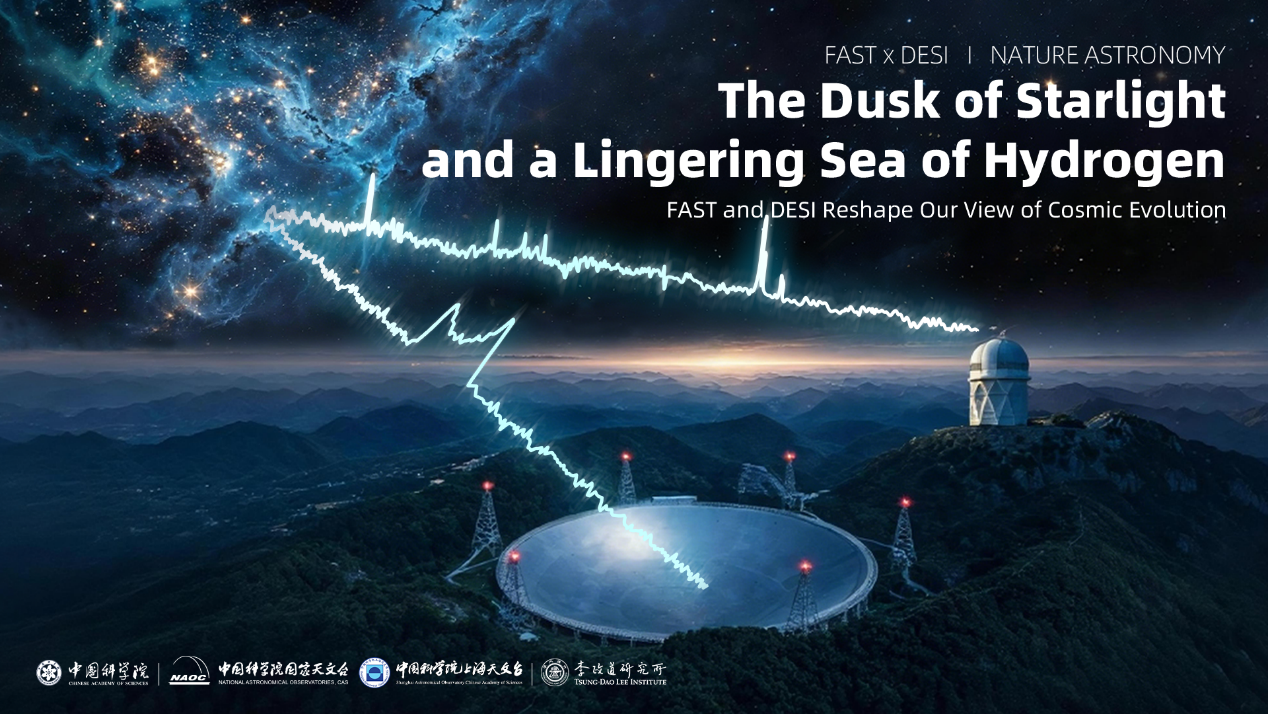
The dusk of starlight and a lingering sea of hydrogen. (Image by National Astronomical Observatories of China, Shanghai Astronomical Observatory of CAS)
<関連情報>
- https://english.cas.cn/newsroom/research-news/202609/t20260901_1189544.shtml
- https://www.nature.com/articles/s41550-026-02965-9
過去45億年にわたる宇宙の原子状水素の弱い進化 Weak evolution of cosmic atomic hydrogen over the past 4.5 billion years
Chuan-Peng Zhang,Hong Guo,Yizhou Gu,Amélie Saintonge,Xiaohu Yang,Dirk Scholte,Ming Zhu,Peng Jiang,Hu Zou,Manasvee Saraf,Wenlin Ma,Yirong Wang,Y. P. Jing,Zheng Zheng,Zhejie Ding,J. Aguilar,S. Ahlen,D. Bianchi,D. Brooks,T. Claybaugh,A. de la Macorra,P. Doel,E. Gaztañaga,G. Gutierrez,… B. A. Weaver
Nature Astronomy Published:01 September 2026
DOI:https://doi.org/10.1038/s41550-026-02965-9
Abstract
The cosmic star formation rate density (CSFRD) has declined sharply towards the present day, but the roles of the atomic and molecular gas reservoirs remain uncertain. Here we measure the cosmic H I density, ΩHI, over 0 < z < 0.41 by combining H I spectra from the Five-hundred-meter Aperture Spherical Telescope with optical spectroscopy from the Dark Energy Spectroscopic Instrument for ~2.5 million galaxies across ~12,000 deg2. We measure a raw decrease in ΩHI by a factor of 1.35 ± 0.10 over the past 4.5 Gyr. Even after applying the conservative systematic corrections from our forward model, the inferred decline is only 1.12 ± 0.10—still far weaker than the CSFRD decline (a factor of 2.46). The molecular gas density, by contrast, is known to evolve more closely with star formation. At fixed stellar mass, the average H I gas fraction evolves by less than 0.2 dex, showing that the weak evolution is present across the galaxy population. These quantitative differences rule out rapid depletion of galaxy H I as the primary driver of the late-time CSFRD decline, and provide a stringent benchmark for models of gas accretion, phase conversion and star-formation regulation.