2026-08-25 総合研究大学
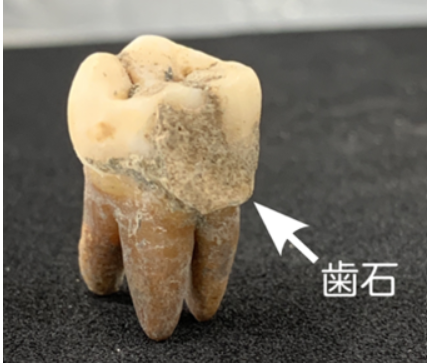
図1. 大深町遺跡(梅田墓)出土古人骨の歯と、歯に付着した歯石の一例。
歯の表面に盛り上がって付着した暗色のザラザラした塊が歯石。
<関連情報>
- https://www.soken.ac.jp/news/2026/20260825.html
- https://www.jstage.jst.go.jp/article/ase/advpub/0/advpub_260519/_article
大阪における前近代の庶民の食生活の復元:ヒト歯石の古タンパク質分析による研究 Dietary reconstruction of individual premodern commoners in Osaka, Japan, through the palaeoproteomic analysis of human dental calculus
Yoko Uchida-Fukuhara, Mariko Iida, Shigenobu Oba, Rikai Sawafuji, Takumi Nishiuchi, Shiori Fujisawa, Tomohito Nagaoka, Takumi Tsutaya
Anthropological Science Published:August 19, 2026
DOI:https://doi.org/10.1537/ase.260519
Abstract
Food systems is an analytical framework developed in agricultural economics that encompasses the entire process from food production, processing, distribution, preparation, to consumption. In archaeology, the distinction between food supply, which indicates the presence of food resources within a region, and accessibility, which reflects the extent to which individuals could actually obtain these resources, potentially enables a more nuanced reconstruction of past human diets. In this study, we utilized this food system framework to investigate the accessibility of food items for commoners in premodern Osaka, a logistical hub with a diverse food supply. Carbon and nitrogen stable isotope analysis of bone collagen and palaeoproteomic analysis of dental calculus were performed for eight skeletal individuals from the Ofuka-cho site. The stable isotope ratios were within the previously reported ranges for premodern commoners in Japan. A total of 38 dietary proteins across 17 taxa were identified in the calculus. The identified food items included Pagrus major, which was an economically high-grade fish, Salmonidae, which was traded over long distances, the meat of terrestrial mammals, which were publicly avoided during this period, and cottonseed, which was possibly used as an edible oil. These findings reflect high accessibility to diverse food items even among commoners, which was maintained by the well-developed transport network of premodern Osaka. These results emphasize the pivotal role of commoners in the development of Japan’s culinary culture.