2026-08-03 ローレンス・バークレー国立研究所(LBNL)
<関連情報>
- https://newscenter.lbl.gov/2026/08/03/new-ai-modeling-approach-accelerates-the-development-of-advanced-materials/
- https://www.nature.com/articles/s41563-026-02596-5
イオン相関は、拡散律速固体合成反応における速度論的選択性を説明する Ion correlations explain kinetic selectivity in diffusion-limited solid-state synthesis reactions
Vir Karan,Max C. Gallant,Yuxing Fei,Gerbrand Ceder &Kristin A. Persson
Nature Materials Published:28 April 2026
DOI:https://doi.org/10.1038/s41563-026-02596-5
Abstract
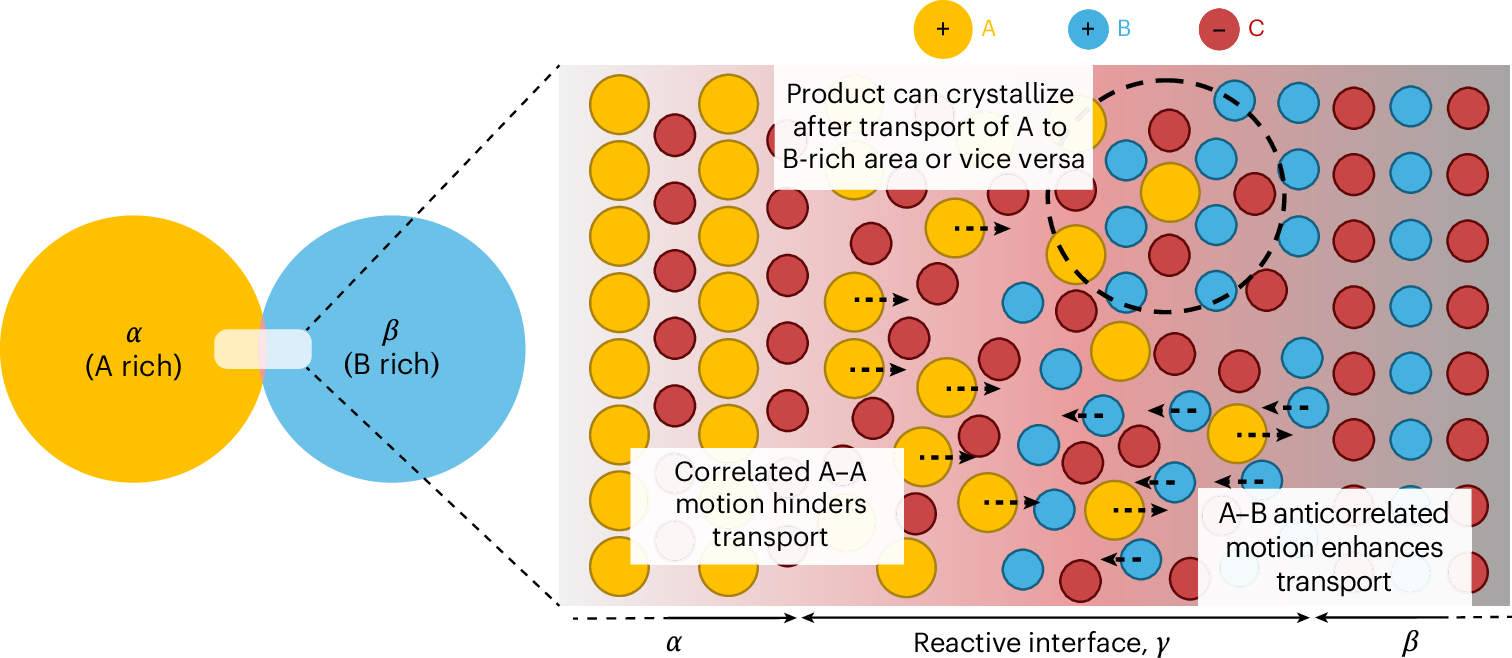
Establishing viable solid-state synthesis pathways for novel inorganic materials remains a major challenge in materials science. Previous pathway design methods using pairwise reaction approaches have navigated the thermodynamic landscape with first-principles data but lack kinetic information, limiting their effectiveness. This gap leads to suboptimal precursor selection and predictions, especially for reactions forming competing phases with similar formation energies, where ion diffusion is a critical influence. Here we demonstrate an inorganic synthesis framework by incorporating machine learning-derived transport properties through ‘liquid-like’ product layers into a thermodynamic cellular reaction model. In the Ba–Ti–O system, known for its competitive polymorphism, we obtain accurate predictions of phase formation with varying BaO:TiO2 ratios as a function of time and temperature. We find that diffusion–thermodynamics interplay governs phase compositions, with cross-ion transport coefficients critical for predicting diffusion-limited selectivity. This work bridges length scales and timescales by integrating solid-state reaction kinetics with first-principles thermodynamics and spatial reactivity.