2026-08-25 神戸大学
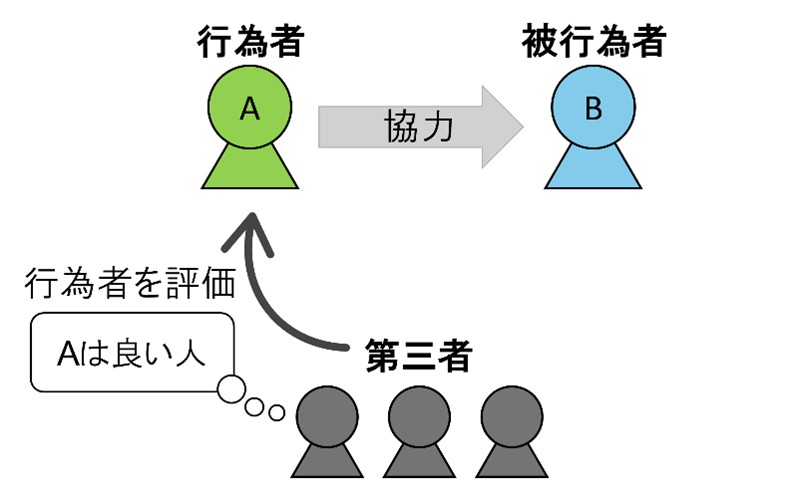
図1 間接互恵性 © Yukari Jessica Tham (CC BY)
<関連情報>
- https://www.kobe-u.ac.jp/ja/news/article/20260825-68206/
- https://www.pnas.org/doi/10.1073/pnas.2624656123
二重の民間評価による間接的な相互主義 Indirect reciprocity with dual private assessment
Yukari Jessica Tham, Christian Hilbe, and Yohsuke Murase
Proceedings of the National Academy of Sciences Published:August 27, 2026
DOI:https://doi.org/10.1073/pnas.2624656123
Abstract
People often cooperate out of concern for their reputation. The corresponding theory of indirect reciprocity predicts that such cooperation can only evolve if people’s opinions of each other are sufficiently correlated. This correlation, however, can be difficult to achieve when individuals form their opinions independently from one another, as in private assessment models. In that case, errors can generate disagreements that propagate throughout a population. Here, we identify a simple mechanism that mitigates this problem. Most prior work assumes that observers revise only the reputations of donors—the individuals who choose whether to cooperate or defect. We instead allow observers to also revise the reputations of recipients—the individuals affected by the donors’ choices. Using analytical calculations and simulations, we show that such dual reputation updates help synchronize opinions and facilitate cooperation. To demonstrate this approach, we focus on a particularly simple rule, which we call Recipient Image Scoring (RIS). Under RIS, recipients are assessed as good whenever donors choose to cooperate with them. We show that this rule for judging recipients effectively complements the classical leading-eight rules for judging donors. Our results establish dual assessment as a simple mechanism for cooperation that relies only on directly observable information.