2026-07-13 ペンシルベニア州立大学(Penn State)
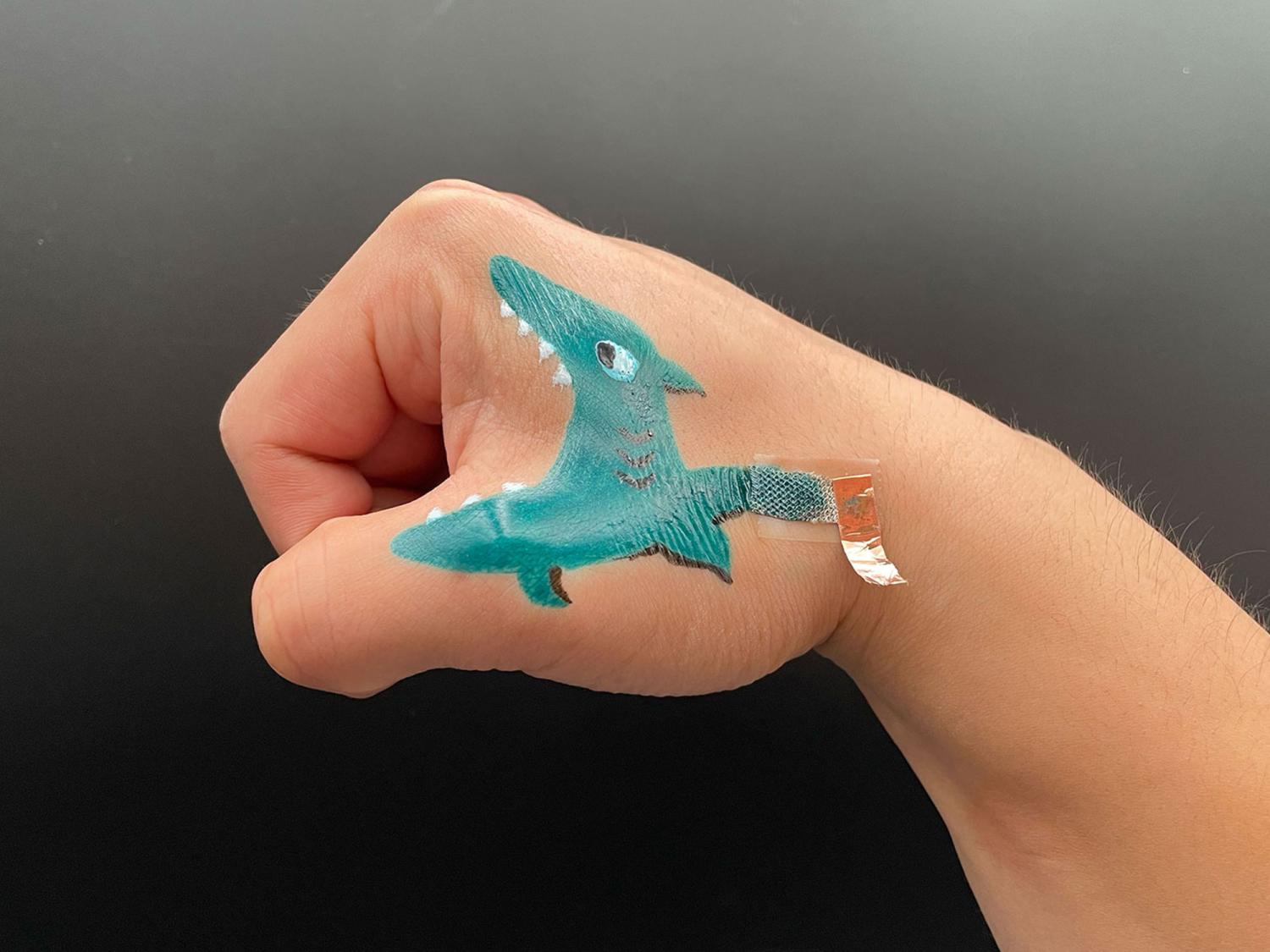
Using a conductive, face-paint-like ink, researchers can now paint electrodes to monitor a wearer’s heart, muscle or brain activity in style. Credit: Provided by Wanqing Zhang. All Rights Reserved.
<関連情報>
- https://www.psu.edu/news/research/story/paintable-electrodes-could-power-creative-and-colorful-wearable-sensors
- https://www.pnas.org/doi/10.1073/pnas.2615835123
皮膚に塗布可能な乾式電極で、皮膚とデバイス間の接続が強固であり、ワイヤレスセンシングやヒューマンマシンインターフェースに利用可能 Paintable on-skin dry electrodes with robust skin and device connection for wireless sensing and human–machine interfaces
Wanqing Zhang, Xin Xin, Yuqi Wang, +14 , and Huanyu Cheng
Proceedings of the National Academy Sciences Published:July 13, 2026
DOI:https://doi.org/10.1073/pnas.2615835123
Abstract
Reliable and continuous electrophysiological recording is important for health monitoring and human–machine interactions. However, most existing epidermal electrodes suffer from either limited skin–electrode contact during skin deformation and sweating, or unstable connections between soft electrodes and relatively rigid data acquisition systems due to the inherent mechanical mismatch. Besides, their lack of personalization further discourages long-term use, particularly among children, adolescents, and individuals sensitive to stigma. Here, this work presents a paintable, drawn-on-skin dry electrode that forms an ultraconformal interface on hierarchically textured skin topographies with a thickness gradient to minimize interfacial stress, achieving low contact impedance (10.8 kΩ cm2) and high adhesion (~963 kPa) on skin. The resulting electrodes are customizable in shape and color, transforming them from “medical devices” into playful wearable accessories, thus enhancing user compliance and long-term wearability. Moreover, the in situ paintability enables seamless integration with porous silver textile connectors, yielding an interlocked junction with a built-in modulus gradient for stable signal transmission. The versatility of this platform is demonstrated through diverse use cases, including wireless electrocardiogram monitoring during long-term complex daily activities, machine learning-enabled electromyogram for gesture recognition and robotic hand control, and through-hair electroencephalogram detection for neural response analysis. In addition, the absence of image artifact highlights its potential for multimodal MRI imaging and electrophysiology. Overall, this strategy establishes a personalized, scalable platform for next-generation electronic tattoos toward continuous healthcare and interactive bioelectronics.