2026-07-14 サンディア国立研究所
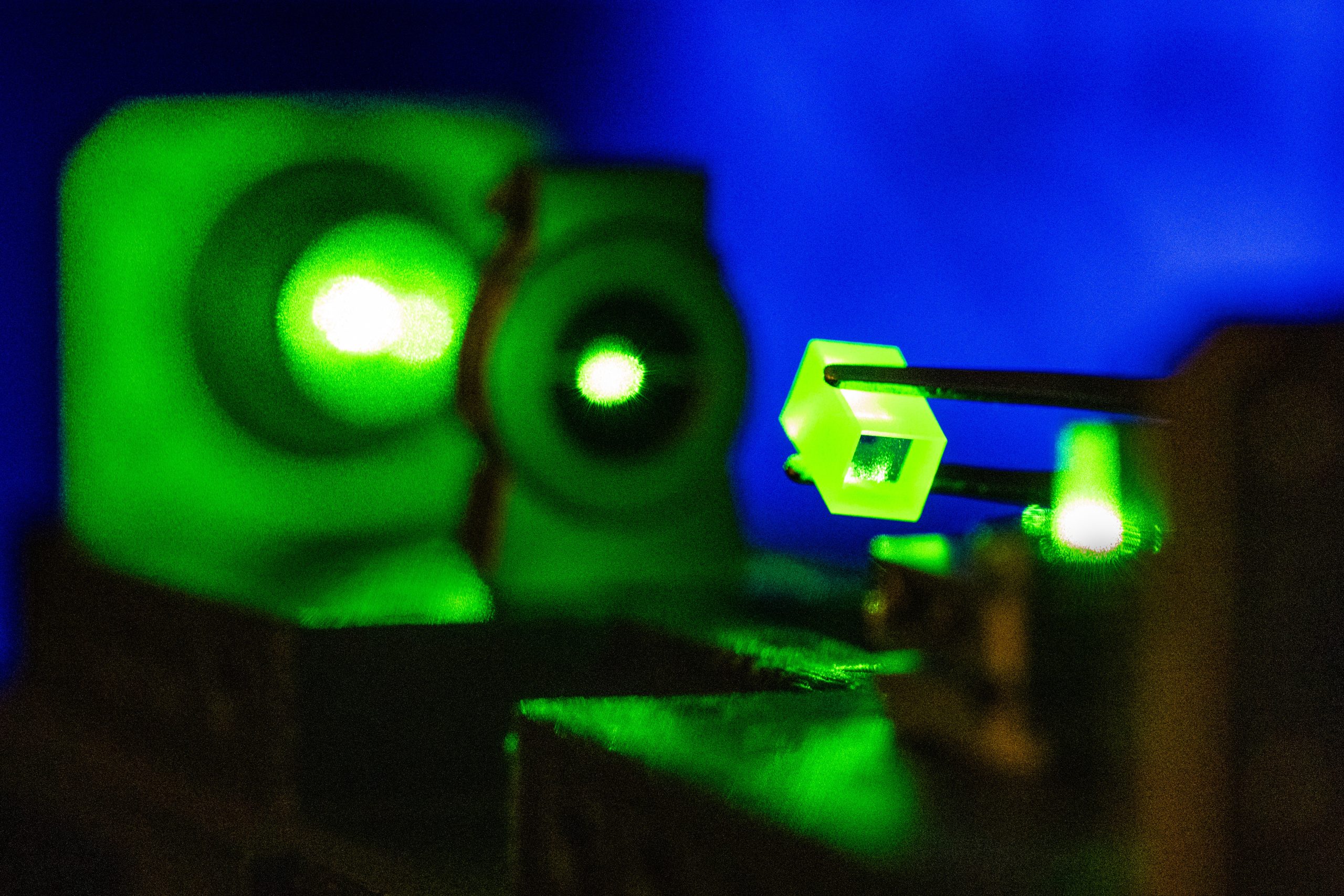
A rare earth garnet used by Sandia National Laboratories researchers to measure intense magnetic fields, such as those needed for fusion research and high-energy physics experiments. Here, the crystal is being illuminated by a green laser. (Photo by Craig Fritz) Click on the thumbnail for a high-resolution image.
<関連情報>
- https://newsreleases.sandia.gov/magnetic-field-sensors-for-fusion/
- https://pubs.aip.org/aip/adv/article/13/10/105006/2914692/Magneto-optical-measurement-of-magnetic-field-and
短パルス高エネルギーパルスパワー加速器における磁場および電流の磁気光学測定
Magneto-optical measurement of magnetic field and electrical current on a short pulse high energy pulsed power accelerator
Israel Owens;Sean Coffey;Ben Ulmen;Richard K. Harrison;Alex Trujillo;Elaine Rhoades;Brandon McCutcheon;Chris Grabowski
AIP Advances Published:October 05 2023
DOI:https://doi.org/10.1063/5.0171543
We describe a direct magneto-optical approach to measuring the magnetic field driven by a narrow pulse width (<10 ns), 20 kA electrical current flow in the transmission line of a high energy pulsed power accelerator. The magnetic field and electrical current are among the most important operating parameters in a pulsed power accelerator and are critical to understanding the properties of the radiation output. However, accurately measuring these fields and electrical currents using conventional pulsed power diagnostics is difficult due to the strength of ionizing radiation and electromagnetic interference. Our approach uses a fiber coupled laser beam with a rare earth element sensing crystal sensor that is highly resistant to electromagnetic interference and does not require external calibration. Here, we focus on device theory, operating parameters, results from an experiment on a high energy pulsed power accelerator, and comparison to a conventional electrical current shunt sensor.