2026-07-10 マサチューセッツ工科大学(MIT)
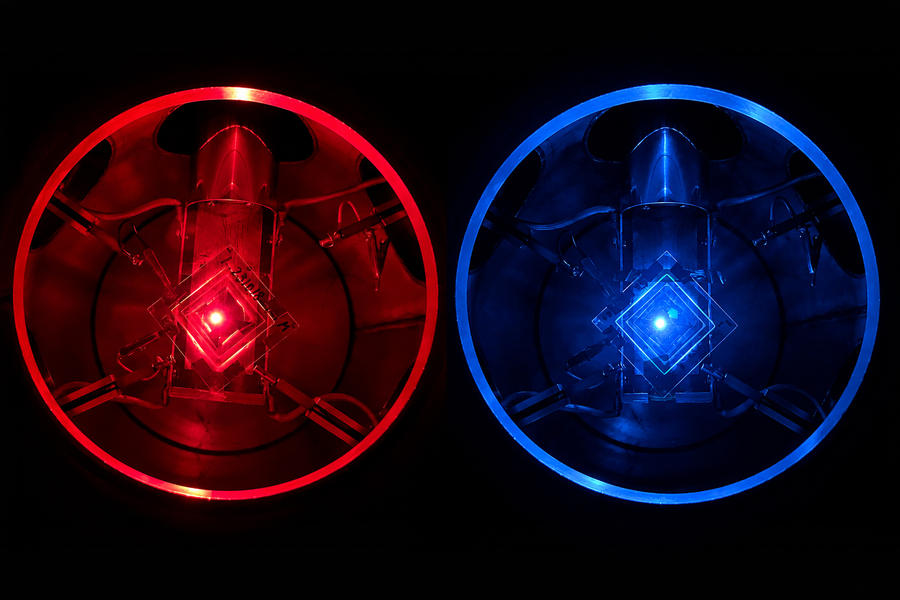
MIT researchers studied the microscopic changes that occur inside LEDs that utilize electrically-excited quantum dots, which are nanoscale particles that emit extremely pure colored light. Credit: Courtesy of the researchers
<関連情報>
- https://news.mit.edu/2026/discovery-could-lead-brighter-more-energy-efficient-digital-displays-0710
- https://www.science.org/doi/10.1126/sciadv.aec8208
動作中のカドミウムフリーコロイドQD-LEDの形態学的および化学的変化 Morphological and chemical changes in Cd-free colloidal QD-LEDs during operation
Ruiqi Zhang, Jamie Geng, Shaun Tan, Mike Dillender, […] , and Vladimir Bulović
Science Advances Published:10 Jul 2026
DOI:https://doi.org/10.1126/sciadv.aec8208
Abstract
Heavy-metal-free quantum-dot light-emitting devices (QD-LEDs) demonstrate high brightness, saturated color, and high efficiency, yet their operational lifetimes remain limited, with the underlying degradation mechanisms not fully understood. Here, we show that InP/ZnSe/ZnS (red-emitting) and ZnTeSe/ZnSe/ZnS (blue-emitting) colloidal QD-LEDs undergo nanoscale morphological changes during operation. Interparticle coarsening and layer thinning are observed in the core functional layers, accompanied by the generation and diffusion of compositional-oxygen and hydrogen across the device, with oxygen accumulating at the Al electrode/ZnMgO electron-transport layer (ETL) interface. In situ transmission electron microscopy reveals that electron beam exposure, in presence of atomic hydrogen species, accelerates ZnMgO nanoparticles coarsening. To mitigate these degradation pathways, we show that acrylate-based resin encapsulation can stabilize the ETL, HTL, and QD layers by suppressing atomic species formation and halting morphology changes. This approach achieves over 50-fold and 5000-fold lifetime improvement in InP/ZnSe/ZnS and ZnTeSe/ZnSe/ZnS QD-LEDs, respectively. Our findings establish the causal relationships between morphological degradation, interlayer dynamics, and QD-LED instability, providing insight into the acrylate encapsulation treatment that enables efficient and long-lived QD-LEDs.